
A manpower requisition form (MRF) is the internal request a department head raises to get approval for a new or replacement hire. It records the role, the reason, the CTC band, the budget line and who approved it. HR starts sourcing only once it is signed.
The form itself is not required by law. But it is the last cheap point to check three things the law does care about: whether the vacancy has to be reported to a career centre under the Code on Social Security, 2020, whether the candidate criteria are gender-neutral under the Code on Wages, 2019, and whether contract labour is allowed for the work under the OSH Code, 2020. This guide gives you a one-page format, a sample approval matrix, those three checks and three worked examples.
As at 23 November 2026. Covers the Code on Social Security, 2020 (in force since 21 November 2025), the Social Security (Central) Rules, 2026 and the Central Government notifications of 8 May 2026. Nothing here is legal advice.
| Item | What to know | Basis | Section |
|---|---|---|---|
| Is an MRF a legal form? | No. Approvals are a company decision | None | 1, 5 |
| Fields that change the law | Job location (state) and employment type | Practice | 3 |
| Vacancy reporting to a career centre | Required before filling a vacancy, from the date your appropriate government notifies | Code on Social Security, s.139; Central Rules, 2026, rule 56 | 6 |
| Who is covered (central sphere) | Public sector, and private establishments with 20 or more employees, from 6 August 2026 | S.O. 2341(E); rule 56(1); s.140(1)(f) | 6 |
| Main exclusions | Jobs under 90 days, filling by promotion, pay under ₹11,000 a month (central sphere), domestic service, private agriculture | s.140; S.O. 2343(E) | 6 |
| Reporting lead time | 15 days before the last date for applications (regional career centre); 40 days for the central career centre | Rule 56(4) | 6, 8 |
| Result of selection | Within 30 days of selection | Rule 56(4)(c) | 6, 8 |
| Yearly return | Form XXVI, within 30 days of 31 March | Rule 56(6) | 6 |
| Gender in the candidate section | No discrimination on the ground of sex in recruitment for the same or similar work | Code on Wages, s.3(2)(ii) | 6 |
| Contract labour | Barred in core activities, with three exceptions, where 50 or more contract workers are engaged | OSH Code, ss.45 and 57 | 6 |
What is a manpower requisition form?
An MRF, also called a job requisition or headcount request, turns "we need someone" into an approved, costed vacancy. In most Indian companies the department head raises it, HR checks it against the manpower plan, finance confirms the money, and a business head or the CEO approves anything outside the budget.
Three documents get mixed up:
- MRF (requisition): the internal approval to hire. It answers "should we hire, and at what cost?"
- Job description (JD): what the person will do and what they need to know. It answers "what is the job?" Use our job description template.
- Job posting: the public advert, built from the JD once the MRF is approved.
MRF stands for manpower requisition form. Some companies call it a manpower request form or a position requisition. The purpose is the same.
Why an MRF matters more than it looks
Without a signed MRF, hiring runs on corridor conversations. A plant manager asks for "two more supervisors", HR starts calling candidates, and in March finance finds a salary cost nobody budgeted. The MRF fixes four things:
- Budget control. Every hire is tied to a cost centre and a CTC band before an offer goes out.
- A clean start date for metrics. Our recruitment analytics guide measures time to fill from requisition approval to offer acceptance. With no approval date, there is no honest time-to-fill number.
- Legal checks. The form is the natural place to record the employment type, the location and the career-centre reporting duty before anyone advertises.
- An audit trail. When a new CFO asks why headcount went from 240 to 290, the approved MRFs answer it.
What fields should an MRF have?
Keep it to one page. This is the format we suggest for an Indian company of 100 to 1,500 people. The last column says why each field is there.
| Section | Field | Why it matters |
|---|---|---|
| Request | MRF number, date raised, raised by | Unique ID for tracking and audit |
| Request | Department, cost centre, reporting manager | Ties the cost to the right budget line |
| Role | Designation, grade or band, number of positions | Stops grade inflation at offer stage |
| Role | Location (city and state), work mode | The state decides PT, LWF and minimum wage, and which career centre and government apply |
| Reason | New position or replacement; for a replacement, the leaver's name and last working day | Backfills and growth hires follow different approval routes |
| Reason | Business case in two or three lines | Makes the manager state the need |
| Type | Permanent, fixed-term, apprentice, intern, or contract labour through a contractor | Each type carries different law and cost |
| Type | Duration, if not permanent | Jobs lasting less than 90 days are outside the career-centre reporting duty |
| Cost | CTC range (minimum to maximum, ₹ per year), variable pay, joining bonus if any | Finance approves a band, so the offer has room |
| Cost | Budgeted or unbudgeted; budget code | Unbudgeted roles need a higher approver |
| Cost | Expected recruitment cost (agency fee, job board, referral bonus) | Feeds cost per hire |
| Candidate | Minimum qualification, experience range, must-have skills | HR can screen without going back to the manager |
| Hiring | Sourcing channels (internal posting, referral, agency, campus) | Internal-first policies need a record |
| Hiring | Interview panel and rounds | Avoids delays once candidates are lined up |
| Hiring | Target joining date | Basis for the hiring plan and the payroll cost |
| Compliance | Career-centre reporting needed? (Yes/No), vacancy reporting number, date reported | Evidence that the vacancy was reported, if it had to be |
| Approval | Department head, HR, finance, business head or CEO, with dates | The approval trail |
The two fields people leave out and regret are the state of the job location and the employment type. Both change what the law asks of you, as section 6 shows.
What is the manpower requisition process, step by step?
This route suits a company of 100 to 1,500 people. Smaller firms can merge steps 3 and 4.
- The manager raises the MRF. The department head fills the form, attaches the JD, and says whether the role is a replacement or a new position.
- HR checks it against the manpower plan. Is the role in this year's approved headcount? Is the grade right for the work? Is the CTC band in line with peers? HR also confirms the location state and the employment type.
- Finance confirms the budget. For a budgeted role this is a quick cost-centre check. For an unbudgeted role, finance states the cost for the rest of the financial year and the full-year cost.
- Final approval. The business head or CEO approves roles that are unbudgeted, senior or above band.
- HR gives it a requisition number and opens the vacancy. This date is day zero for time to fill.
- Compliance step. If the career-centre duty applies, HR reports the vacancy in time (section 6) and writes the vacancy reporting number on the MRF.
- Sourcing starts. Internal posting first if your policy says so, then referrals, job boards and agencies.
- Close the MRF. On offer acceptance, record the candidate, final CTC and joining date. If the MRF is cancelled or put on hold, record why. Then send the result of selection to the career centre if the vacancy was reported.
Set a turnaround target for steps 1 to 5, such as five working days, and track it. If approvals drag, managers stop using the form.
Who should approve an MRF? A sample approval matrix
No law decides who approves a hire. The matrix below is a starting point. Adjust the bands to your pay structure.
| Request type | Department head | HR | Finance | Business head or CEO |
|---|---|---|---|---|
| Replacement, same grade, within band | Raises | Approves | Informed | Not needed |
| Replacement at a higher grade or above band | Raises | Approves | Approves | Approves |
| New position, budgeted | Raises | Approves | Approves | Informed |
| New position, unbudgeted | Raises | Approves | Approves | Approves |
| Any role with CTC above ₹25 lakh a year (example threshold) | Raises | Approves | Approves | Approves |
| Fixed-term or project role under 12 months | Raises | Approves | Approves | Informed |
The first row follows our backfill glossary entry: pre-approve like-for-like replacements within agreed headcount and keep the full route for exceptions. A resignation already has a notice period running, so a backfill MRF that waits two weeks for a CEO signature wastes much of it.
Is a manpower requisition legally required in India?
No law tells you how to approve a hire internally. But three legal checks belong on the form.
1. Reporting the vacancy to a career centre (Code on Social Security, 2020)
Section 139 lets the appropriate government require employers, from a notified date, to report a vacancy to a career centre before filling it. A career centre can be an employment exchange, an office, a place or a portal (s.2(9)). The Code repealed the Employment Exchanges (Compulsory Notification of Vacancies) Act, 1959 (s.164), so this is the duty that replaces it. Reporting does not oblige you to recruit through the career centre (s.139(3)).
Who is covered depends on your appropriate government. Under s.2(3), the Central Government is the appropriate government for central-sphere establishments (such as railways, mines, ports, banking and insurance companies, and central PSUs) and for any establishment with departments or branches in more than one state. For other establishments, it is the state government.
- Central sphere: S.O. 2341(E) of 8 May 2026 made the duty apply to every public and private sector establishment from 90 days after the Social Security (Central) Rules, 2026 were notified on 8 May 2026, that is, from 6 August 2026.
- State sphere: the state's own rules and notifications decide when the duty starts for private establishments. Check your state's notification before treating the duty as live for a single-state company.
Under the Central Rules, 2026 (G.S.R. 344(E), rule 56), a private establishment means one with 20 or more employees, or another number the Centre notifies. The mechanics are:
| Point | Rule | Rule number |
|---|---|---|
| How to report | Form XXV, in writing, by official email or digitally, one entry per type of vacancy | 56(3) |
| Vacancy reporting number | The government's digital system issues a unique number within 3 working days (7 in north-eastern states) | 56(1)(c) |
| Where | The career centre (regional) for most vacancies. Until a state notifies its career centres, the existing local employment exchange acts as one | 56(2)(c); 55(1) |
| Central career centre | Technical and scientific posts above a notified pay in central-sphere establishments, and vacancies you want circulated outside your state. An employer filling a vacancy across branches in several states may report it centrally or to each regional centre | 56(2)(a), (b) |
| Lead time (regional) | At least 15 days before the last date for receiving applications | 56(4)(a) |
| Lead time (central) | At least 40 days before the last date for receiving applications | 56(4)(b) |
| Result of selection | Within 30 days of the date of selection | 56(4)(c) |
| Yearly return | Employment Information Return in Form XXVI, within 30 days of 31 March, so by 30 April | 56(6) |
What is excluded. Section 140 keeps these out: employment in agriculture (including horticulture) in a private establishment, other than plantations; domestic service; jobs lasting less than 90 days; private establishments with fewer than 20 employees; and, unless the Centre directs otherwise, vacancies filled by promotion or by absorbing surplus staff of the same establishment. For the central sphere, S.O. 2343(E) of 8 May 2026 also excludes vacancies paying total wages of less than ₹11,000 a month. A state may notify its own amount.
Penalty. The Code has no special penalty for not reporting a vacancy, so the general clause applies: a fine of up to ₹50,000 under s.133, with a higher penalty for a repeat offence under s.134. Not filing a return falls under the same fine.
The Ministry of Labour and Employment runs the National Career Service portal (ncs.gov.in), where employers can register and post vacancies and find career centres. Ask your local career centre which mode it accepts for the Form XXV report.
2. Gender-neutral hiring (Code on Wages, 2019)
Section 3(2)(ii) of the Code on Wages bars an employer from discriminating on the ground of sex "while recruiting any employee for the same work or work of similar nature", except where a law prohibits or restricts the employment of women in that work. An MRF that says "male candidates only" for a sales or accounts role puts the problem in writing. Leave gender out of the candidate section unless a specific legal restriction applies.
3. Contract labour in core activities (OSH Code, 2020)
If the MRF asks for contract workers through a contractor, check section 57 of the OSH Code. Where Part I of the Code applies (establishments with 50 or more contract workers in the last twelve months, s.45), contract labour in core activities is barred unless the work is normally done through a contractor, does not need full-time workers for most of the day, or is a sudden rise in work that must be finished in a set time. For a direct, time-bound role, a fixed-term employment contract is often the cleaner choice.
Worked example 1: costing an unbudgeted new role
A Pune distributor with 410 employees wants one more area sales executive from 1 November 2026. The role is not in the FY 2026-27 budget. The approved band tops out at a CTC of ₹7,80,000 a year, which is ₹65,000 a month. Say the agency charges 8.33% of annual CTC (use your own contract rate).
| Item | Working | Amount |
|---|---|---|
| Salary cost for the rest of FY 2026-27 | ₹65,000 × 5 months (November to March) | ₹3,25,000 |
| Agency fee | 8.33% × ₹7,80,000 | ₹64,974 |
| Cost in this financial year | ₹3,89,974 | |
| Full-year salary cost from FY 2027-28 | ₹65,000 × 12 | ₹7,80,000 |
Because the role is unbudgeted, the matrix sends it to the CEO. The MRF should show both numbers: about ₹3.9 lakh this year and ₹7.8 lakh a year after that. Approving only the first is how budgets overrun next year. CTC already includes the employer's PF share, so do not add PF again. Our CTC breakup guide shows what usually sits inside CTC.
Worked example 2: reporting factory vacancies to the career centre
An auto-components company has a plant in Nashik and a sales office in Bengaluru, with 320 employees. Because it has branches in more than one state, the Central Government is its appropriate government and the reporting duty has applied since 6 August 2026. In November 2026 the plant raises three MRFs:
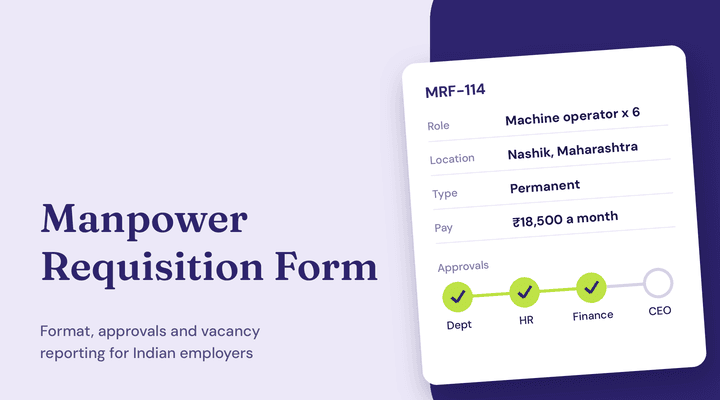
- MRF-114: six permanent machine operators at ₹18,500 a month. Applications close on 15 December 2026.
- MRF-115: two helpers for a 60-day order surge.
- MRF-116: one line leader, to be filled by promoting an operator.
| MRF | Report? | Why | Deadline |
|---|---|---|---|
| 114 | Yes | Private establishment with 20 or more employees; permanent; pay above ₹11,000 a month | Report to the regional career centre by 30 November 2026 (15 days before 15 December) |
| 115 | No | Employment lasting less than 90 days is excluded (s.140(1)(d)) | None |
| 116 | No | Vacancies filled by promotion are excluded (s.140(2)(a)) | None |
The 40-day central lead time does not apply here. Operator posts are not technical and scientific posts above a notified pay, and the company is not asking for circulation outside Maharashtra.
If the six operators are selected on 8 January 2027, the result of selection goes to the career centre by 7 February 2027 (30 days). The hires then appear in the Form XXVI return due by 30 April 2027. The plant can still hire through referrals and walk-ins. Reporting the vacancy is a duty to inform. It does not oblige the plant to recruit from the career centre.
Worked example 3: a backfill at a higher salary
A senior accountant earning ₹6,60,000 a year resigns. The finance controller raises a replacement MRF but wants to hire at up to ₹7,80,000 because the market has moved. That is ₹1,20,000 more than the old cost, an 18.2% rise. Under the sample matrix this is a replacement above band, so it needs finance and CEO sign-off as well as HR. Write the reason on the MRF, for example "three candidates at ₹6.6 lakh declined". It saves the same argument at the offer stage, and again at the next appraisal when the new hire's pay is compared with peers.
MRF checklist for HR
- One MRF format for the whole company, with an MRF number on every request
- Replacement or new position marked; leaver's name and last working day for replacements
- Location state recorded, since it drives PT, LWF, minimum wage and the career centre
- Employment type chosen: permanent, fixed-term, apprentice, intern or contract labour through a contractor
- For contract labour, the OSH Code core-activity test done and recorded
- CTC band in ₹ per year, cost for the current financial year and the full-year cost
- Budget code; unbudgeted roles sent to the final approver
- No gender, age or other criteria unrelated to the job in the candidate section
- Career-centre check: is the duty live for your establishment, 20 or more employees, job of 90 days or more, pay at or above the notified floor, and the post is not being filled by promotion
- Vacancy reported 15 days (regional) or 40 days (central) before the application deadline; vacancy reporting number noted
- Approval dates captured; requisition opened (day zero for time to fill)
- On closure: final CTC, joining date, result of selection reported within 30 days, MRF closed
Common mistakes with manpower requisitions
- Approving one salary figure instead of a band. The first good candidate asks for 10% more and the MRF goes back round the loop.
- Showing only this year's cost. A role approved in January looks cheap for three months and costs a full year from April.
- Treating every backfill as a new request. Like-for-like replacements inside approved headcount should move fast. Keep the scrutiny for growth roles.
- Leaving the employment type blank. HR then issues a permanent appointment letter for what the manager meant as a six-month project role.
- Advertising with a deadline that is too close. If the career-centre duty applies, the 15 days are counted back from the last date for applications. Set that date with the report in mind.
- MRFs that never close. Requisitions that are really on hold distort time-to-fill numbers. Close or freeze them with a reason.
- Approvals on WhatsApp. A thumbs-up in a group chat is not an audit trail.
How HR software helps with requisitions
An MRF in Excel works for ten hires a year. At fifty, the sheet goes out of date, approvals sit in inboxes, and nobody can say how many roles are open. Engage is an HRMS for Indian companies with 50 or more employees. Its recruitment module covers the steps around the MRF:
- Requisitions and internal postings. The recruitment software takes requisition submissions and runs internal job postings and a referral system.
- Approvals by level. Each requisition goes through the approval levels you set, such as department head, HR and finance, before the role opens.
- From approval to hire. A central applicant tracking system, interview scheduling and feedback, and offers generated and sent from the platform, which candidates can accept before completing their own onboarding.
- Access control. Core HR has roles and permissions, so each user sees only the data their role allows.
Keep the approval matrix and the career-centre fields in your MRF format, whichever tool you use. Once the hire is made, our employee onboarding checklist and probation period guide cover the next steps, and the offer letter template and interview evaluation form cover the steps in between.
FAQ
What is a manpower requisition form?
It is an internal form a department head raises to get approval to hire. It records the role, the reason (new or replacement), the CTC band, the budget line, the employment type and the approvers. HR starts recruiting only after it is approved.
What is the MRF full form in HR?
MRF stands for manpower requisition form. It is also called a job requisition, manpower request form or headcount request.
What is the manpower requisition process?
The manager raises the MRF, HR checks it against the manpower plan, finance confirms the budget, and a senior leader approves anything unbudgeted or above band. HR then opens the requisition, reports the vacancy to a career centre if required, and starts sourcing.
What is the format of a manpower requisition form?
A good format fits on one page: request details, role and grade, location state, reason for hiring, employment type, CTC band and budget code, candidate requirements, sourcing channels, a career-centre reporting field, and approvals with dates.
Who approves a manpower requisition?
Usually the department head raises it, HR and finance approve it, and the business head or CEO signs off unbudgeted, senior or above-band roles. Indian law does not set approvers; it is company policy.
Do private companies in India have to report vacancies to the employment exchange?
The 1959 Act has been repealed. Under section 139 of the Code on Social Security, 2020, private establishments with 20 or more employees must report vacancies to a career centre before filling them, from the date their appropriate government notifies. For central-sphere and multi-state establishments that date is 6 August 2026. Jobs under 90 days, promotions and, in the central sphere, jobs paying under ₹11,000 a month are excluded.
How many days before hiring must a vacancy be reported?
Under rule 56 of the Social Security (Central) Rules, 2026, at least 15 days before the last date for applications for a regional career centre, and at least 40 days for the central career centre. The result of selection goes in within 30 days of selection.
What is the difference between a job requisition and a job description?
The requisition is the approval to hire and the cost. The job description sets out the duties and requirements. You usually attach the JD to the MRF.
To see what Engage would cost for your team, check Engage pricing.
Sources
- Code on Social Security, 2020, sections 2(3), 2(9), 133, 134, 139, 140 and 164, Ministry of Labour and Employment.
- Social Security (Central) Rules, 2026, G.S.R. 344(E), 8 May 2026, rules 55 and 56, Ministry of Labour and Employment.
- S.O. 2341(E), 8 May 2026, date for reporting vacancies under section 139, Ministry of Labour and Employment.
- S.O. 2343(E), 8 May 2026, vacancies paying less than ₹11,000 a month, Ministry of Labour and Employment.
- Code on Wages, 2019, section 3, Ministry of Labour and Employment.
- Occupational Safety, Health and Working Conditions Code, 2020, sections 2(1)(p), 45 and 57, DGFASLI.
- National Career Service, Directorate General of Employment.