The number on an Indian offer letter is not a salary. It is an accounting total that includes money the employee will never see in a bank account, money they will see only after five years, and in some companies money that exists only because somebody wanted the headline figure to start with a bigger digit.
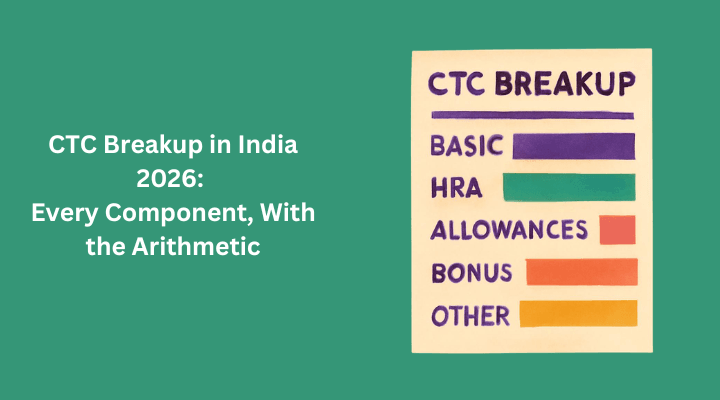
What follows is a CTC breakup done properly: one real structure, component by component, with the arithmetic shown. At the end of it you should be able to take any offer letter and say which lines are cash, which are deferred, which are a cost to the company that is not a benefit to the employee, and which should not be in the total at all.
The single most useful thing to know before you start: what counts as "wages" changed on 21 November 2025, and most salary structures in this country were designed under the old definition. If your structure was built before then and nobody has looked at it since, the components you think are outside PF and gratuity probably are not. Section 7 covers this and it is the part with money attached.
Figures here are current at August 2026 and reflect the Code on Wages and the Code on Social Security as in force, along with the Code on Wages (Central) Rules, 2026 notified on 8 May 2026. State rules under the codes are still being notified in parts, professional tax is a state subject, and tax slabs change annually. Treat the numbers as the shape of the rule rather than something to hard code. Nothing here is tax or legal advice.
What CTC Actually Is, and What It Is Not
Cost to Company is exactly what the name says: the total annual cost the employer books against one employee. It is an employer-side number that got repurposed as a candidate-facing one, which is the root of nearly every argument about it.
CTC is not defined anywhere in Indian law. There is no statute that says what may be included, no prescribed format, and no penalty for putting something odd in it. The Code on Wages defines wages, the Code on Social Security defines what contributions are due, and the Income-tax Act defines what is taxable. None of them defines CTC. That absence is why two companies can quote the same CTC and pay take-home amounts that differ by fifteen per cent.
The practical consequence is that comparing two offers on CTC alone is close to meaningless. What you compare is the four layers underneath it.
| Layer | What it is | When the employee gets it |
|---|---|---|
| Fixed cash | Basic, DA, HRA, allowances that are paid monthly | Every month, less deductions |
| Retirals | Employer PF, gratuity provision, employer NPS where offered | PF on exit or retirement, gratuity after five years |
| Variable | Performance bonus, incentive, retention pay | Conditionally, usually annually, often prorated |
| Notional | Insurance premiums, subsidised meals, transport, training budgets | As a benefit in kind, never as cash |
Fixed cash is the only layer that reliably becomes take-home. Everything else is a promise, a deferral, or a benefit whose cash value to the employee is usually well below what it cost the employer.
The Worked Example We Will Use Throughout
An offer for a mid-level role in Bengaluru. The letter says CTC ₹12,16,260 per annum, which is the sort of unrounded figure a payroll system produces when somebody has worked backwards from a monthly gross. Here is the whole structure.
| Component | Per month | Per year |
|---|---|---|
| Basic salary | ₹50,000 | ₹6,00,000 |
| House rent allowance | ₹25,000 | ₹3,00,000 |
| Special allowance | ₹22,000 | ₹2,64,000 |
| Monthly gross | ₹97,000 | ₹11,64,000 |
| Employer PF contribution | ₹1,800 | ₹21,600 |
| EDLI and PF admin charges | ₹150 | ₹1,800 |
| Gratuity provision at 4.81% of basic | ₹2,405 | ₹28,860 |
| Total CTC | ₹1,01,355 | ₹12,16,260 |
Now the other direction, from gross to what lands in the account.
| Line | Per month |
|---|---|
| Monthly gross | ₹97,000 |
| Less employee PF contribution | ₹1,800 |
| Less professional tax, Karnataka | ₹200 |
| Less TDS | ₹0 |
| Net take-home | ₹95,000 |
So a CTC of ₹1,01,355 a month becomes ₹95,000 in hand. The gap is ₹6,355, about 6.3 per cent, and it is unusually small. We will get to why, and to the structures where the same CTC produces ₹88,000 instead.
The zero TDS is not a mistake. Under the new regime the standard deduction of ₹75,000 brings taxable income to ₹10,89,000, tax on that is ₹48,900, and the Section 87A rebate of up to ₹60,000 applies to total income up to ₹12,00,000, which wipes it out. A person on ₹11.64 lakh of gross salary pays no income tax at all in FY 2026-27. We cover the mechanics in TDS on salary, old regime versus new.
Basic Salary, and Why Its Percentage Decides Everything Else
Basic is the anchor. It is the base for PF, for gratuity, for most HRA arithmetic, for leave encashment and for overtime. Almost every other number in the structure is a percentage of it or is constrained by it.
The old convention was to keep basic at 30 to 40 per cent of gross. The reason was not subtle: a lower basic means lower PF, lower gratuity provision and a lower cost per employee, and it means higher take-home for the employee too, which made it an easy sell on both sides. In our example basic is ₹50,000 against a gross of ₹97,000, a little over 51 per cent, which is deliberate and which we explain in section 7.
What a low basic actually costs the employee is deferred rather than immediate. Less goes into PF, so the retirement corpus is smaller. Gratuity is calculated on last drawn basic, so a career of low-basic structures produces a materially smaller exit payment. If you are choosing between two offers with identical CTC and one has basic at 50 per cent while the other has it at 30, the second pays more this month and less over ten years.
Dearness allowance sits alongside basic and is treated as part of it for every statutory calculation. Outside public sector undertakings, banks and some manufacturing settlements, most private employers in India do not run a separate DA line at all, and fold it into basic. If your structure has no DA, that is normal and not a defect.
House Rent Allowance, the Component Most Often Set Wrong
HRA is usually 40 or 50 per cent of basic, and the number is set by convention rather than by law. There is no statutory minimum or maximum. What the law governs is how much of it escapes tax, and that is where structures go wrong: companies set HRA at a level that does not match what the employee can actually claim.
The exemption is the least of three amounts:
- the actual HRA received
- rent paid minus 10 per cent of salary
- 50 per cent of salary in a metro city, or 40 per cent elsewhere
"Salary" for this calculation means basic plus DA that forms part of retirement benefits, plus any commission calculated as a fixed percentage of turnover. It does not include HRA itself or other allowances, which is the mistake people make when they run it in their heads.
In our example, if the employee pays ₹30,000 a month in rent: actual HRA is ₹25,000; rent minus 10 per cent of salary is ₹30,000 minus ₹5,000, so ₹25,000; and 50 per cent of basic is ₹25,000. All three land on ₹25,000, so the whole HRA is exempt. That is a well-set structure, and it is well set because somebody checked the rent before writing the offer, which is rare.
Set HRA higher than the rent supports and the excess is simply taxable salary with extra steps. Set it lower and the employee pays tax on income they could have shielded. Neither error costs the employer anything, which is why neither gets fixed.
Two things worth knowing for FY 2026-27. First, the metro list matters more than it used to: the Income-tax Rules, 2026, notified by the CBDT on 20 March 2026 and in force from 1 April 2026, extend the 50 per cent treatment under Rule 279 to Bengaluru, Hyderabad, Pune and Ahmedabad, alongside Delhi, Mumbai, Kolkata and Chennai. The change applies to salary earned from 1 April 2026, so FY 2025-26 still runs on the old four-city list. It is the first change to that list in over two decades and it is worth several thousand rupees a month to a lot of people. Second, none of this exists in the new tax regime. HRA exemption is an old regime benefit only, and under the new regime the entire allowance is taxable. Our HRA calculator runs the three limits for you.
Special Allowance, the Line That Absorbs the Remainder
Special allowance is the balancing figure. Once basic, HRA and any named allowances are set, whatever is left of the agreed gross goes here. It has no definition, no statutory treatment of its own, and it is fully taxable.
It is also the single most misunderstood line in Indian payroll, and section 7 explains why. For now, note that a large special allowance is a sign that the structure was built by picking a gross figure first and reverse-engineering components to fit, rather than by designing components that mean something.
Everything Else on the Earnings Side
| Component | Typical treatment | What to watch |
|---|---|---|
| Conveyance allowance | Fully taxable in the new regime; the old blanket exemption went in 2018 when the standard deduction replaced it | Still appears in structures out of habit. It buys nothing now unless you are on the old regime with a specific transport disability exemption |
| Leave travel allowance | Exempt for actual domestic travel, twice in a block of four calendar years, old regime only | Requires tickets and a claim. Unclaimed LTA is taxable, and a large share of it goes unclaimed every year |
| Medical or wellness allowance | Fully taxable as salary | The old ₹15,000 medical reimbursement exemption is gone. If it is still labelled as exempt in your structure, that is a legacy error |
| Statutory bonus | Payable where wages are within the eligibility limit; commonly 8.33% to 20% of wages | Often built into CTC as though guaranteed at 8.33%. Whether it is genuinely statutory depends on the wage level |
| Performance bonus or variable pay | Taxable when paid | The most common source of the gap between the CTC quoted and the money received. See section 8 |
| Food coupons or meal cards | Exempt up to ₹50 per meal, old regime only | Small, and worth less than the administration it generates for most companies |
The pattern is hard to miss. Almost every allowance-based tax break in Indian payroll is now old-regime-only, and the new regime is the default. A structure with five carefully chosen exempt allowances delivers nothing at all to an employee who has not opted out of the default, which is most employees.
The 50 Per Cent Rule, and the Trap Inside It
This is the section with money attached.
The Code on Wages gives India a single definition of wages for PF, gratuity, ESI, bonus and overtime, replacing the different definitions that used to apply under each separate Act. Wages means all remuneration, and specifically includes basic pay, dearness allowance and retaining allowance. It then excludes a defined list, which includes house rent allowance, conveyance allowance, overtime, commission, statutory bonus, the value of house accommodation and utilities, employer contributions to provident fund, gratuity and retrenchment compensation.
Then comes the rule everyone has heard about: if the excluded components exceed 50 per cent of total remuneration, the excess is added back and treated as wages. The intent is to stop the practice of pushing basic down to 25 or 30 per cent and parking the rest in allowances that escaped every statutory calculation.
Most commentary stops there, and most salary restructuring done in the last year has consisted of raising basic to 50 per cent and declaring the job finished. That misses the more expensive point.
The exclusions are a closed list, and special allowance is not on it. Neither is a generic "other allowance", a "site allowance", a "flexible benefit plan" balance paid in cash, or most of the invented line items that Indian structures carry. Read the definition literally, which is how an inspector will read it, and those components are wages from the start. They are not excluded and then added back under the 50 per cent test; they never left.
Apply that to our example. Basic is ₹50,000 and special allowance is ₹22,000, so wages are ₹72,000 a month, not ₹50,000. The only genuinely excluded component is HRA at ₹25,000, which is 25.8 per cent of the ₹97,000 total. The structure passes the 50 per cent test with a wide margin, which is what people check. But the wage base for PF and gratuity is ₹72,000.
Here is what that does to the same offer, depending on whether the employer restricts PF to the statutory wage ceiling of ₹15,000 or contributes on full wages.
| PF on the ₹15,000 ceiling | PF on full wages of ₹72,000 | |
|---|---|---|
| Employer PF | ₹1,800 | ₹8,640 |
| Employee PF | ₹1,800 | ₹8,640 |
| EDLI and admin charges | ₹150 | ₹150 |
| Monthly take-home | ₹95,000 | ₹88,160 |
| Annual CTC at the same gross | ₹12,16,260 | ₹12,98,340 |
Same gross salary, same job, ₹6,840 a month of difference in take-home and ₹82,080 a year of difference in employer cost. Both are lawful. Restricting the contribution to the ceiling is permitted and common. The point is that this is a decision somebody has to make deliberately, and in a lot of companies it was made by whoever configured the payroll software four years ago.
Contribution rates themselves have not moved. Provident fund is 12 per cent from each side, with the employer's share split 8.33 per cent to the pension scheme, capped at the ceiling, and the balance to PF. EDLI is 0.5 per cent and administrative charges are 0.5 per cent, both on the capped wage base. ESI is 0.75 per cent from the employee and 3.25 per cent from the employer where monthly gross is ₹21,000 or less, or ₹25,000 for employees with disabilities, which does not apply in our example.
Two further consequences of the same definition. The Ministry of Labour and Employment has said that retrospective recovery for periods before the codes came into force will not be required, which removes the worst-case scenario but not the forward-looking exposure. That is a stated position rather than one we can trace to a notification, so do not build a provision around it. And overtime, where it applies, is calculated on the post-code wage definition rather than on bare basic, which is a larger number than most factory payrolls have been using. If you want the full compliance picture rather than the structure question, our Indian payroll compliance guide and the common payroll compliance mistakes post cover it.
What Should Not Be in CTC, and Usually Is
Nothing prohibits any of the items below. They are all common, and all of them inflate a headline number without giving the employee anything they can spend.
Start with the gratuity provision, since it is in our own example and we are not going to pretend otherwise. It is a genuine cost to the employer. It is also an amount that an employee leaving at four years and eleven months receives none of, and counting money with a five-year cliff as part of this year's compensation is defensible accounting and misleading recruitment.
The employer's PF administrative charges and EDLI premium are a smaller version of the same thing, ₹1,800 a year in our example. That is a cost of running a payroll rather than a benefit anybody receives. It sits in the table above for completeness and it should arguably be out of the offer letter.
Group medical insurance is usually the largest notional item, sometimes ₹15,000 to ₹40,000 a year for a family floater. Here the objection is different. The cover is real and often generous, but the employer buys it at a group rate the employee could never obtain individually, so the premium overstates what that employee would otherwise have spent on the same protection.
Then there is variable pay quoted at full target. If the performance bonus is ₹1,50,000 and the company has never paid above 80 per cent, the CTC is overstated by ₹30,000 before anyone starts work. Ask what the payout has actually been for the last three years. A company that will not answer has answered.
Subsidised meals, transport and the notional value of a laptop are rarer in the offer letter itself, but they turn up in internal cost sheets and occasionally leak into the number quoted to candidates.
The reasonable test is whether the employee would spend their own money on the item at the price the employer is booking. Insurance mostly passes. A laptop does not.
How to Read an Offer Letter in Five Minutes
In order, because the order matters.
- Find the monthly gross and ignore the annual CTC entirely for now. Gross is the sum of the earnings lines before any deduction, and it is the only figure that drives take-home.
- Work out basic as a percentage of that gross. Below 40 per cent, ask whether the structure has been reviewed since November 2025. Around 50 per cent is where most compliant structures have landed.
- Check whether the HRA line matches the rent you actually pay, by running the three limits in section 4. If you are on the new regime, skip this step, because it buys you nothing.
- Ask whether PF is calculated on the ceiling or on full wages. It is worth thousands a month and it is almost never stated in the letter, so you will have to ask.
- Separate the fixed pay from the variable, then ask what percentage of the variable has actually paid out in previous years.
- Subtract everything that is not cash: gratuity provision, insurance premiums, admin charges. What remains is the offer.
A candidate who does this arrives at a number that is often 10 to 20 per cent below the headline. That is not a company behaving badly. It is what CTC means.
Designing a Structure, If You Are on the Employer Side
Four things are worth settling before you write a structure down. None of them is difficult. What makes them awkward is that every one of them trades employer cost against employee benefit, and there is no configuration that avoids the trade.
Set basic first and set it at a defensible level. Fifty per cent of gross is the level that survives the 50 per cent test without argument. Lower is lawful if the excluded components genuinely stay under half, but you are then relying on a characterisation that an inspector may not share, particularly for any allowance not named in the exclusion list.
Stop inventing allowance lines. Every component that is not on the statutory exclusion list is wages regardless of what you call it, so a structure with nine allowances carries the same statutory base as one with three, plus nine lines of explaining to do. The tax benefits that once justified the complexity are mostly old-regime-only and most of your employees are on the default.
Decide the PF ceiling question explicitly and write down why. Contributing on full wages is better for employees and costs more. Restricting to ₹15,000 is lawful and cheaper. Either is fine. Not knowing which one your payroll is doing is not.
And a fourth, which is a process point rather than a design one: whatever you decide, the structure has to survive contact with a payroll run. A structure that is correct on a spreadsheet and configured differently in the system is the same as a wrong structure. Our payroll management system holds the structure and the run against the same definition of wages, which is the only reason we mention it here.
Questions People Ask
Why is my take-home so much lower than my CTC?
Because CTC includes items that are not paid to you monthly and in some cases are not paid to you at all. Employer PF goes to your PF account, gratuity provision is an accrual you only receive after five years of service, insurance premiums are paid to an insurer, and variable pay is conditional. In our worked example the gap is about 6 per cent because the structure is lean. Where CTC includes a large variable component and a family insurance premium, a gap of 20 per cent or more is ordinary.
Should basic salary be 50 per cent of CTC or 50 per cent of gross?
Neither, strictly. The Code on Wages test is that excluded components must not exceed 50 per cent of total remuneration, so the test runs on wages against total remuneration rather than against CTC. In practice, setting basic at or above 50 per cent of monthly gross is the structure most employers have adopted because it clears the test in every reading of it. Be careful with any calculation done against CTC, because CTC includes employer contributions that are themselves excluded from the wage definition.
Is special allowance part of wages for PF?
On a literal reading of the Code on Wages, yes. The definition lists what is excluded, and special allowance is not among the exclusions, so it forms part of wages from the start rather than being added back under the 50 per cent test. Many payroll setups still treat it as outside PF, which is the position that carries the most exposure of anything in this article. Take a view with your own advisers, but take one deliberately rather than by default.
Can my employer reduce my basic salary to restructure my CTC?
Reducing basic while keeping CTC constant reduces your PF and your eventual gratuity, and a unilateral reduction in a component of pay is contentious ground. Most restructuring since November 2025 has moved in the opposite direction, raising basic to meet the wage definition, which reduces take-home while increasing retirals. If your take-home fell after a restructuring and your CTC did not change, that is the likely explanation and you are entitled to an itemised comparison.
Does CTC include the employer's PF contribution?
Almost always yes, and it is legitimate: it is a real cost to the company. What is worth checking is whether the contribution is calculated on the ₹15,000 statutory ceiling or on your full wages, because the difference is a factor of nearly five in our example. Two offers with identical CTC can differ materially on this alone.
How do I calculate gratuity from my CTC?
You do not calculate it from CTC. Gratuity is 15 days of last drawn wages for each completed year of service, calculated as wages multiplied by 15, multiplied by years, divided by 26. The gratuity line inside your CTC is an accrual the employer books, usually at 4.81 per cent of basic, and it is not what you eventually receive. The full method, including what the new wage definition did to it, is in our post on gratuity calculation in India, and you can run your own figures in the gratuity calculator.
Which components are tax free in the new regime?
Very few. The standard deduction of ₹75,000 applies, employer contributions to NPS within limits remain available, and gratuity and PF withdrawals retain their own exemptions. HRA, LTA, food coupons and the various allowance exemptions do not apply. A structure designed around exempt allowances is a structure designed for the old regime, which is no longer the default and no longer where most salaried taxpayers sit.
Where This Leaves You
The useful summary is that CTC tells you what you cost, not what you earn, and that the two numbers have drifted further apart as more items got folded into the total. Read the gross, check basic as a share of it, find out how PF is being calculated, and discount the variable by whatever the company has actually paid out.
On the employer side, the honest position is that most Indian salary structures were designed to minimise statutory cost under a definition of wages that no longer exists, and that raising basic to 50 per cent does not finish the job if the structure still carries allowances that were never excluded in the first place. That is a conversation with your advisers, not a configuration change.
If you want to see what a structure produces before you commit to it, our free payslip generator will build the earnings and deductions side from your components, and the HRA calculator and TDS calculator handle the two pieces of arithmetic people most often get wrong. If you are running payroll for more than a handful of people and reconciling structures by hand, that is what our payroll management system is for. A demo takes twenty minutes and we will run one of your own structures through it, ideally your most complicated one rather than your simplest.
Elsewhere in this set: the exit payment in gratuity calculation in India, the tax deducted every month in TDS on salary, old regime versus new, and what the structure has to look like on paper in payslip format and mandatory components. For the wider background on how Indian salary structures are put together, see our earlier guide to employee salary structure in India.