
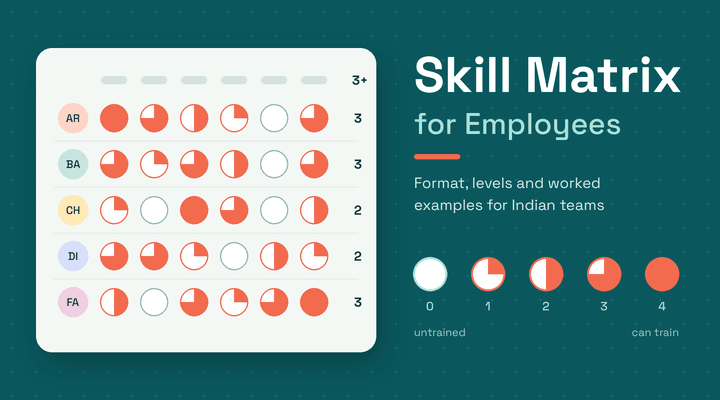
A skill matrix is a grid with employees in the rows and the skills or work stations of a team in the columns. Each cell holds a skill level, usually from 0 to 4. One look tells you who can do what, which stations depend on one person, and what training to plan next. Indian factories also use it to show auditors that people are competent for the work they do.
This guide gives you the level scale, the columns to set up in Excel or an HRMS, two worked examples from an auto-parts plant, and the points where a skill matrix touches Indian labour law: safety training under the OSH Code and minimum wage skill categories under the Code on Wages.
As at 23 November 2026. Legal references are to the Code on Wages, 2019 and the Occupational Safety, Health and Working Conditions (OSH) Code, 2020, both in force since 21 November 2025, and to ISO 9001:2026. Nothing here is legal advice.
| Item | What to know | Basis | Section |
|---|---|---|---|
| What a skill matrix shows | People against skills or stations, with a level of 0 to 4 in each cell | Common practice | 1 |
| Skill vs training matrix | A training matrix records courses done; a skill matrix records what a person can actually do | Common practice | 1 |
| Level that counts as qualified | Level 3: works alone to standard on output, quality and safety, with a sign-off | Your own level descriptors | 2 |
| Is it required by law? | No Indian law names it. It is the easiest way to show safety training and supervision in a factory | OSH Code, 2020, s.6(2)(c) | 4 |
| Link to minimum wages | Minimum wages are fixed mainly by skill: unskilled, semi-skilled, skilled, highly skilled | Code on Wages, 2019, s.6(6)(a); Central Rules, 2026, rule 2(1) | 4, 9 |
| ISO 9001 audits | Clause 7.2 asks you to decide the competence needed, close gaps and keep evidence. It does not name a skill matrix | ISO 9001:2026, clause 7.2 | 4 |
| Cover rule of thumb | At least two qualified people per station per shift | Common practice | 5 |
| How often to update | Each cell when training or sign-off happens; a full review every quarter and before audits | Common practice | 8 |
What is a skill matrix, and how is it different from a training matrix?
People use the terms loosely. In practice there are four related tools, and most Indian plants and offices need the first two.
| Tool | Rows and columns | What each cell shows | Main use |
|---|---|---|---|
| Skill matrix | People against skills or stations | A skill level from 0 to 4 | Planning cover, multi-skilling and training |
| Training matrix | People against required trainings | Done, due or expired, with dates | Proving that required trainings happened: safety induction, forklift, ESD, POSH awareness |
| Competency matrix | Roles against competencies | The level each role needs | Job design, promotion criteria, appraisals |
| Skill-will matrix | One person on two axes | A quadrant | Choosing a coaching style |
A training matrix records attendance. A skill matrix records ability. Someone can attend a two-day CNC programming course and still be at level 1. Keep both and link them, because training is how a person moves from 1 to 3.
For the difference between a skill and a competency, see our competency glossary entry.
Skill matrix levels: the 0 to 4 scale
A scale from 0 to 4 is a common format on Indian shop floors, often drawn as a circle filled in quarters. The descriptions matter more than the numbers. Write them so that two supervisors in two plants would rate the same person the same way.
| Level | Symbol | Meaning | Typical evidence |
|---|---|---|---|
| 0 | Empty circle | Not trained. Must not work on this station or task | None |
| 1 | Quarter | Trained in theory or under training. Works only under supervision | Training record, SOP read and signed |
| 2 | Half | Can do the job with some help. Not yet at standard on output or quality | Supervisor observation, trial run |
| 3 | Three-quarter | Fully qualified. Works alone to standard on output, quality and safety | Sign-off by the supervisor or quality, first-piece record |
| 4 | Full circle | Expert. Can train others, handle abnormal situations and do setups | Has trained at least one person to level 3 |
Office teams often prefer words to numbers: Not exposed, Learning, Practising, Proficient, Can teach. The logic is the same.
What columns should a skill matrix format have?
A skill matrix in Excel or an HRMS needs a few fixed fields plus one column for each skill:
- Employee details: employee code, name, department, line or cell, shift and date of joining.
- One column per skill or station, with the level entered as a number (0 to 4) so it can be counted.
- Target level for each skill, by role. A CNC operator may need 3 on turning but only 1 on packing.
- Date of last assessment and the name of the person who assessed.
- Row total: the number of stations where the person is at level 3 or above. This is their multi-skill count.
- Column totals: people at level 3 or above for each station (cover), and people at level 4 (trainers).
- Gap flag: stations where cover on any shift is below your minimum.
In Excel, store the levels as numbers and use conditional formatting for colour. If levels sit in C2:H9, then =COUNTIF(C2:C9,">=3") gives the cover for the station in column C, and =COUNTIF(C2:H2,">=3") gives the multi-skill count for the person in row 2. =COUNTIF(C2:C9,4) counts trainers.
To list the skills for an office role, start from the job description. Our job description template helps.
Is a skill matrix mandatory in India?
No Indian law uses the term or asks for one. Three things still make it close to standard practice in factories.
Safety training under the OSH Code
Section 6(2)(c) of the OSH Code, 2020 says that the duties of an employer of a factory, mine, dock, building or construction work or plantation include providing "such information, instruction, training and supervision as are necessary to ensure the health and safety of all employees at work". A skill matrix, with its training matrix, is the simplest way to show who was trained and cleared for which machine, and who must still work under supervision.
Minimum wages by skill under the Code on Wages
Section 6(6)(a) of the Code on Wages, 2019 tells the government to fix minimum wages mainly by the skill the work needs, in four categories (unskilled, semi-skilled, skilled and highly skilled), or by geographical area, or both. The Code on Wages (Central) Rules, 2026 define the four categories in rule 2(1). State rules and notifications set the rates for state-sphere employers. State rates are on our minimum wages pages.
| Category | Definition in the Central Rules, 2026 (shortened) | Rule |
|---|---|---|
| Unskilled | Needs only simple operating experience and no further skills | 2(1)(u) |
| Semi-skilled | Uses skill gained by experience on the job, applied under the supervision or guidance of a skilled employee; includes supervising unskilled work | 2(1)(s) |
| Skilled | Needs skill and competence from experience on the job or training as an apprentice in a technical or vocational institute, and calls for initiative and judgment | 2(1)(t) |
| Highly skilled | Needs a specific level of perfection and competence from intensive technical or professional training or long practical experience, and full responsibility for judgments and decisions | 2(1)(m) |
The skill matrix levels and the wage categories are not the same scale, but they overlap. A person rated 3 works alone and makes their own calls at that station, which reads closer to the skilled definition than to semi-skilled. If your matrix shows a helper paid at the semi-skilled rate now working alone as a qualified operator, check whether their wage category should change. See section 9.
Quality system audits
Clause 7.2 of ISO 9001 asks an organisation to decide the competence needed by people whose work affects its quality system, make sure they are competent through education, training or experience, act on gaps and check that the action worked, and have documented evidence of competence. ISO 9001:2026, published on 16 September 2026, kept these requirements. Plants certified to the 2015 edition have until 30 September 2029 to move to the new one.
ISO 9001 does not name a skill matrix, but auditors often ask to see one, because it answers clause 7.2 on one sheet. Automotive suppliers certified to IATF 16949:2016 have two more clauses: 7.2.1 asks for a documented process to identify training needs and achieve competence, and 7.2.2 asks for on-the-job training for anyone in a new or changed role that affects quality, including contract and agency staff.
Worked example 1: a machining cell in an auto-parts plant
An auto-parts supplier in Hosur runs a machining cell on the general shift with 8 operators and 6 stations. This is the skill matrix the production supervisor filled in last month.
| Operator | CNC turning | VMC milling | Deburring | Gauge inspection | Heat-treat loading | Packing | Stations at 3 or above |
|---|---|---|---|---|---|---|---|
| Arun | 4 | 3 | 2 | 1 | 0 | 3 | 3 |
| Bala | 3 | 1 | 3 | 2 | 0 | 3 | 3 |
| Chitra | 1 | 0 | 4 | 3 | 0 | 2 | 2 |
| Dinesh | 3 | 3 | 1 | 0 | 2 | 1 | 2 |
| Farhan | 2 | 0 | 3 | 1 | 3 | 4 | 3 |
| Gopi | 0 | 2 | 1 | 0 | 3 | 3 | 2 |
| Harish | 3 | 3 | 0 | 1 | 1 | 1 | 2 |
| Imran | 1 | 0 | 2 | 0 | 0 | 4 | 1 |
| Qualified (3 or above) | 4 | 3 | 3 | 1 | 2 | 5 | 18 |
| Trainers (4) | 1 | 0 | 1 | 0 | 0 | 2 | 4 |
Read the column totals first. A common shop-floor rule is at least two qualified people per station per shift, so that one absence or resignation does not stop the line.
- Gauge inspection has one qualified person, Chitra. If she is on leave, parts either wait or go out without inspection. This is the first training priority. Bala is already at 2 and can reach 3 fastest.
- Gauge inspection, VMC milling and heat-treat loading have no trainer. Each needs outside help to train anyone new. Arun, Dinesh and Harish are at 3 on VMC; develop one of them to 4. Chitra is the obvious person to take gauge inspection to 4.
- Packing has five qualified people and two trainers. That is more cover than it needs. Do not spend training hours there.
Then read the row totals. Imran is qualified on one station, so he is the hardest person to move when volumes shift. Training him on deburring, where he is at 2, helps both him and the line.
Across the cell, 18 of 48 cells (37.5%) are at level 3 or above. Track that one number every quarter to see whether multi-skilling is moving.
Worked example 2: turning gaps into a training plan for a quality team
The same plant's quality department has five people. The quality head set target levels for the role (3 on CMM programming, MSA and gauge R&R, and SPC; 2 on PPAP documentation) and estimated the training hours needed to move up one level: 16 hours for CMM, 8 for MSA, 6 for SPC and 8 for PPAP.
| Person | CMM (target 3) | MSA (target 3) | SPC (target 3) | PPAP (target 2) | Levels short | Training hours |
|---|---|---|---|---|---|---|
| Senior inspector | 3 | 3 | 2 | 3 | 1 | 6 |
| Inspector A | 1 | 2 | 2 | 1 | 5 | 54 |
| Inspector B | 0 | 2 | 3 | 1 | 5 | 64 |
| Inspector C | 2 | 1 | 1 | 0 | 7 | 60 |
| Trainee | 0 | 0 | 1 | 0 | 10 | 100 |
| Total | 28 | 284 |
Each person's hours are their gap in levels multiplied by the hours per level, added across skills. A level above target does not offset a gap elsewhere. Inspector B, for example, is 3 levels short on CMM (48 hours), 1 on MSA (8) and 1 on PPAP (8), which makes 64 hours.
| Skill | Levels short | Hours per level | Hours |
|---|---|---|---|
| CMM programming | 9 | 16 | 144 |
| MSA and gauge R&R | 7 | 8 | 56 |
| SPC | 6 | 6 | 36 |
| PPAP documentation | 6 | 8 | 48 |
| Total | 28 | 284 |
CMM programming alone needs 144 of the 284 hours. That changes the plan in two ways. First, CMM is where a paid outside course is worth it. Second, MSA (56 hours) and SPC (36 hours) can be taught in-house once one person reaches level 4. The trainee's 100 hours belong in their onboarding plan and should stay out of the department's yearly training budget. Our employee onboarding checklist covers how to plan those first months.
How to build a skill matrix: step by step
- Pick the unit. One line, cell or team per matrix. A 40-column matrix for a whole department is unreadable.
- List the skills or stations. Use the process flow or SOP list on the shop floor, and the job description for office roles. Keep it to 6 to 15 columns.
- Write level descriptions for each skill. What does a 3 on gauge inspection look like? Tie it to output, quality and safety.
- Set target levels by role and a minimum cover for each station on each shift.
- Assess people. Use supervisor observation plus evidence such as first-piece reports, defect data or a practical test. Self-ratings are useful input, but not the final rating.
- Work out the totals: cover and trainers for each column, the multi-skill count for each row, and the share of all cells at 3 or above.
- Mark the gaps in red and rank them. Stations that depend on one person come first, then stations with no trainer, then people below target.
- Turn the gaps into a training plan with names, trainer, hours and a target date. Record each training in the training matrix.
- Re-assess and sign off after training. Only a supervisor or quality sign-off moves someone to 3.
- Display and review. Put the line's matrix on the shop-floor board, and review it every month in production meetings and before every audit.
How often should a skill matrix be updated?
| Trigger | What to do |
|---|---|
| Training completed or sign-off given | Update that cell the same week |
| New joiner, transfer or exit | Add or remove the row before their first or last shift on the line |
| New machine, product or process change | Add the column. Everyone starts at 0 or 1 until assessed |
| Someone away from a station for 3 months or more | Re-check before putting them back at 3 |
| Routine | Full review every quarter, and before ISO or customer audits |
A matrix last touched before the previous audit is worse than none, because it gives false comfort.
Should skill levels be linked to pay and grades?
Yes, with care. Many plants pay a multi-skill allowance or use the matrix for operator promotions (helper to operator to setter), and that gives people a reason to learn. Our glossary entry on competency-based pay covers the wider idea. Three cautions:
- Minimum wage category. Wage categories turn on the work the person actually does. If the matrix shows someone doing skilled work on their own while paid at the semi-skilled rate, that is a compliance risk. Check the definitions in section 4 and your state's notification.
- Rating inflation. Once money is attached, supervisors rate generously. Ask for evidence and a second signature for any move to 3 or 4.
- Keep it apart from the appraisal rating. A skill matrix measures what a person can do on each task. An appraisal measures results over a year. Use one as input to the other, but do not merge them. Our guide to the bell curve appraisal covers how ratings are spread.
The matrix is also useful at the end of probation. A new operator who has reached the target level on their core stations has a clear case for confirmation. See our guide to probation period rules in India.
Common mistakes with skill matrices
- Too many columns. Forty skills per person means nobody updates it. Group minor tasks.
- No level descriptions. "3 = good" lets every supervisor score differently. Write what each level looks like for each skill.
- Confusing attended with able. A training certificate moves someone to 1. Only a sign-off on the job moves them to 3.
- Rating people but never reading the columns. The column totals, cover per station, are where the business risk sits.
- Built once for the audit, then frozen. Auditors check dates. So do your own line leaders.
- Ignoring shifts. Six qualified people on a station is no use if all six are on the general shift.
- Excel copies everywhere. Each line keeps its own version, nobody knows which is current, and joiners and leavers are missed.
How HR software helps with a skill matrix
A skill matrix is only useful while it is current. In Excel it drifts away from the employee master: new joiners are missing, people who left are still counted as cover, and training records sit in another file. Engage is an HRMS for Indian companies with 50 or more employees. It keeps the records a skill matrix depends on in one place:
- Training evidence. The learning and development module lets you assign courses by role or department. Each module can carry a quiz with a pass score you set, and completion status and quiz results are tracked for every employee. Reminders go out before a training deadline, and admins are told if it is missed.
- Shop-floor training. For plants, the manufacturing HRMS covers safety inductions and refreshers with quiz-based assessments, assigned by department or role.
- One employee list. Shifts are set up once and assigned in bulk by line or department in attendance, and the shop floor and office sit in one employee database. Your matrix rows then match the people actually on each shift.
The skill levels themselves still come from your supervisors' assessments. Build the first matrix for one line using the format above, and keep the training records behind each level in the same system as the employee record.
FAQ
What is a skill matrix?
A skill matrix is a grid of employees against the skills or work stations their team needs, with each cell showing a skill level, commonly 0 to 4. It shows who can do what, where cover is thin and what training to plan.
What are the levels in a skill matrix?
The usual scale is 0 (not trained), 1 (under training, works under supervision), 2 (can do the job with some help), 3 (fully qualified, works alone to standard) and 4 (expert who can train others). Write a description for each level for each skill.
How do I make a skill matrix format in Excel?
Put employees in rows and skills in columns, enter levels as numbers from 0 to 4, and add target levels by role. Use COUNTIF to count people at level 3 or above in each column and skills at 3 or above in each row, then colour the cells with conditional formatting.
What is a skill matrix for a production department?
It lists operators against the stations or machines on a line, shows who is qualified on each, and flags stations with fewer than two qualified people per shift. Production heads use it to plan shifts, cover absences and decide cross-training.
What is the difference between a skill matrix and a training matrix?
A training matrix records which trainings each person has completed and when they expire. A skill matrix records how well each person can actually do each task. Training moves people up the skill matrix.
Is a skill matrix mandatory for ISO 9001 or IATF 16949?
No. Clause 7.2 of ISO 9001 asks you to decide the competence needed, make sure people have it and keep documented evidence, but it does not name a skill matrix. Auditors at ISO 9001 and IATF 16949 plants often ask to see one because it shows that evidence on one sheet.
Is a skill matrix linked to minimum wages in India?
Indirectly. Under section 6(6)(a) of the Code on Wages, 2019, minimum wages are fixed mainly by skill category: unskilled, semi-skilled, skilled and highly skilled. If the matrix shows someone doing skilled work alone, check that they are paid at least the skilled rate for your state.
How often should a skill matrix be updated?
Update cells as training or sign-offs happen, add or remove rows when people join or leave, and do a full review every quarter and before audits.
Can a skill matrix be used for office teams?
Yes. Replace stations with skills (for a payroll team: statutory returns, full and final settlements, reconciliations, tax computation), use word labels for the levels if you prefer, and apply the same cover rule so that no task depends on one person.
To see what Engage would cost for your team, check Engage pricing.
Sources
- Code on Wages, 2019, section 6, Ministry of Labour and Employment.
- Code on Wages (Central) Rules, 2026, G.S.R. 343(E), 8 May 2026, rule 2(1)(m), (s), (t) and (u), Ministry of Labour and Employment.
- Occupational Safety, Health and Working Conditions Code, 2020, section 6, DGFASLI.
- ISO 9001:2026, Quality management systems, Requirements, International Organization for Standardization.
- ISO 9001:2026 publication and transition timeline, ISO/TC 176.