
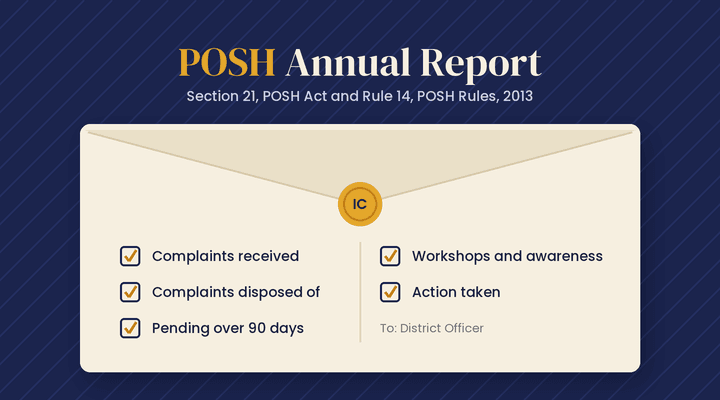
Under section 21 of the POSH Act, 2013, every Internal Committee prepares an annual report for each calendar year and sends it to the employer and the District Officer. Rule 14 of the POSH Rules, 2013 lists five things it must contain: complaints received, complaints disposed of, cases pending for more than 90 days, awareness programmes held, and the action taken. Neither the Act nor the central Rules set a filing date. Your District Officer does.
The report is short. The work is in getting clean dates and attendance records ready by 31 December. This guide covers what goes in it, who files it, where and by when, and how to count the numbers so they match your Board's report.
As at 21 November 2026. The POSH Act is not one of the four Labour Codes, so the Codes that came into force on 21 November 2025 did not change this report. Nothing here is legal advice.
| Item | Rule | Basis | Section |
|---|---|---|---|
| Who prepares the report | The Internal Committee, once each calendar year | POSH Act, 2013, s.21(1) | 1 |
| Who receives it | The employer and the District Officer | s.21(1) | 3 |
| What it must contain | Complaints received, disposed of, pending over 90 days, awareness programmes, action taken | POSH Rules, 2013, rule 14 | 2 |
| Form and due date | Not prescribed centrally. Use your district's format and date | s.21(1); rule 14 | 2, 3 |
| Employer's own duty | Show the number of cases and their disposal in the organisation's annual report, or tell the District Officer if there is no such report | s.22 | 5 |
| Employer must chase the IC | Monitor the timely submission of IC reports | s.19(j) | 1 |
| Inquiry time limit | 90 days | s.11(4) | 2 |
| Board's report (companies) | Complaints received, disposed of and pending over 90 days for the financial year, plus a Maternity Benefit Act statement | Companies (Accounts) Rules, 2014, rule 8(5)(x) and (xiii), from 14 July 2025 | 5 |
| Penalty | Fine of up to ₹50,000; on a repeat conviction, up to twice that and possible loss of licence or registration | s.26 | 9 |
What is the POSH annual report?
It is a yearly summary of sexual harassment complaints and prevention work, prepared by the Internal Committee (IC) under the Sexual Harassment of Women at Workplace (Prevention, Prohibition and Redressal) Act, 2013. Three provisions create it:
- Section 21(1): the IC prepares the report "in each calendar year" and submits it to the employer and the District Officer. Under s.21(2), the District Officer sends a summary of all the reports to the State Government.
- Section 22: the employer includes the number of cases filed and their disposal in its own annual report. If it does not prepare one, it tells the District Officer directly.
- Section 19(j): the employer must monitor the timely submission of reports by the IC.
In practice, the IC signs the report, HR puts it together and sends it, and for a company the Board's report carries the headline numbers.
Who has to file it?
Every IC. Section 4(1) requires an IC at every workplace, and at each office or administrative unit where the workplace is spread across locations. So a company with a plant in one district and an office in another has two ICs and two reports. Workplaces with fewer than ten workers do not have an IC; complaints from them go to the district's Local Committee (s.6(1)).
A year with no complaints still needs a report. The ICC and POSH policy templates on our site cover setting up the committee: see the Internal Complaints Committee template and the POSH policy template.
What goes in the POSH annual report (Rule 14)
Rule 14 of the POSH Rules, 2013 fixes the content. The central Rules do not give a form, so some districts publish their own. Gurugram, for example, publishes a compliance checklist for non-government organisations. Where your district has no format, use the five Rule 14 heads in this order.
| Rule 14 clause | What to report | How to count it |
|---|---|---|
| 14(a) | Complaints of sexual harassment received in the year | Complaints received from 1 January to 31 December, by date of receipt |
| 14(b) | Complaints disposed of during the year | Complaints closed in the year, whether by an inquiry report, a settlement through conciliation under s.10 or withdrawal, including any received in an earlier year |
| 14(c) | Cases pending for more than 90 days | The Rule does not say from when. A common reading: complaints still open on 31 December that were received more than 90 days earlier |
| 14(d) | Workshops or awareness programmes against sexual harassment | Every session in the year: staff awareness, IC orientation, manager training. Keep the attendance sheets |
| 14(e) | Nature of action taken by the employer or District Officer | One line per disposed case (warning, withheld increment, termination, no action because not proven), with no names |
The 90-day figure matters because s.11(4) gives the IC 90 days to complete an inquiry. Clause 14(c) is how a District Officer spots committees that are sitting on complaints.
A simple POSH annual report format
- Covering letter on letterhead to the District Officer, signed by an authorised signatory, giving the calendar year and the list of enclosures.
- Part A, organisation: legal name, address of the workplace or unit, nature of business, and employees (women and men) on 31 December.
- Part B, the IC: Presiding Officer, at least two employee members and one external member, with tenure end dates. At least half must be women, and no member serves more than three years (s.4(2), 4(3)).
- Part C, complaints: rows for 14(a), 14(b) and 14(c), plus complaints carried in from the previous year so the numbers add up.
- Part D, prevention work: sessions under 14(d), with dates, audience and headcount.
- Part E, action taken: one line per disposed case under 14(e).
- Declaration signed by the Presiding Officer and the employer's authorised signatory.
Never include the names of the complainant, respondent or witnesses. Section 16 bars making them public, and the District Officer does not need them. Use case numbers.
When is the POSH annual report due, and where do you file it?
There is no national date. Section 21 says the report is prepared "in such form and at such time as may be prescribed", and the central Rules prescribe no time. The date comes from your District Officer. Two examples from official sources:
- Gurugram, Haryana: a District Officer notice of 4 November 2024 asks every government and non-government organisation to submit the calendar-year report by 28 February of every year. The district POSH page says reports are accepted only by email, from the organisation's official email address, with the district checklist. The notice also warns of a ₹50,000 penalty for late filing.
- Maharashtra: a Women and Child Development Department circular of 14 May 2026 authorises officers to inspect establishments under s.25 of the Act. Its checklist asks whether the IC sends its annual report to the employer and the District Officer every year, and whether the annual report has been uploaded on SHe-Box. The same circular records that each district's Deputy Collector is the District Officer.
If your district has not notified a date, file early in the new year. Ask the district's POSH office in December for its date, format and mode (email, post or portal). Deadline tables on private websites often cite no order, so rely on the district's own notice.
File with the District Officer of the district where the workplace or unit sits. The IC also gives the same report to the employer under s.21(1). Keep the acknowledgement, whether a stamped copy or an email reply, in the IC file.
Is SHe-Box registration the same as filing the annual report?
No. SHe-Box is the Ministry of Women and Child Development portal, launched on 29 August 2024. Workplaces register there and update their IC details, and women can file complaints that are routed to the IC. In the Aureliano Fernandes case, the Supreme Court's orders of 3 December 2024, 12 August 2025 and 6 January 2026 directed District Officers to survey workplaces for ICs and directed States to put the data on SHe-Box, as the Ministry told Parliament on 1 April 2026.
Registering on SHe-Box does not replace the report to the District Officer under s.21. Do both: register each IC on the portal and keep it current, and file the annual report the way your district asks. In Maharashtra, also upload the report on SHe-Box, since the state's inspection checklist asks for it.
POSH annual report vs the Board's report disclosure
A company reports POSH numbers twice, to two audiences, over two different periods. Most mistakes come from treating them as one report.
| IC annual report (POSH Act) | Board's report (Companies Act) | |
|---|---|---|
| Legal basis | s.21, POSH Act; rule 14, POSH Rules | Rule 8(5)(x) and (xiii), Companies (Accounts) Rules, 2014 |
| Period | Calendar year (January to December) | Financial year (April to March) |
| Prepared by | Internal Committee | Board of directors, usually drafted by the company secretary |
| Goes to | Employer and District Officer | Shareholders, and filed with the Registrar of Companies |
| Applies to | Every IC, company or not | Companies |
| Complaint data | Received, disposed of, pending over 90 days | Received, disposed of, pending over 90 days |
| Other content | Awareness programmes; action taken | Statement on IC constitution; statement on Maternity Benefit Act compliance |
Rule 8(5)(x) already required the Board's report to state that the company had complied with the provisions on constituting the IC. The Companies (Accounts) Second Amendment Rules, 2025 (G.S.R. 357(E), dated 30 May 2025, in force from 14 July 2025) added the three complaint counts to that clause, and a new clause (xiii) for a statement on compliance with the Maternity Benefit Act, 1961. Our maternity leave rules guide covers what that statement rests on.
Keep one complaint register with dates of receipt and disposal, and run both reports from it. Example 2 below shows why the two sets of numbers will differ, and should.
Worked examples
An auto-components company has about 565 employees: a plant in Chakan, Pune (520 people) and a sales office in Gurugram (45 people). Each location has its own IC. The Pune IC's register shows five complaints:
| Case | Received | Disposed of | Days |
|---|---|---|---|
| P1 | 20 Nov 2025 | 10 Feb 2026 | 82 |
| P2 | 4 Mar 2026 | 22 May 2026 | 79 |
| P3 | 15 Jul 2026 | 30 Oct 2026 | 107 |
| P4 | 1 Sep 2026 | Open | 121 days old on 31 Dec 2026 |
| P5 | 25 Nov 2026 | Open | 36 days old on 31 Dec 2026 |
Example 1: the Pune IC's report for calendar year 2026
- 14(a) received in 2026: 4 (P2, P3, P4, P5). P1 was received in 2025, so it was in last year's count.
- 14(b) disposed of in 2026: 3 (P1, P2, P3). P1 counts here because it was closed in 2026.
- 14(c) pending more than 90 days on 31 December 2026: 1 (P4, at 121 days). P5 is open but only 36 days old.
- Check line for Part C: 1 carried in from 2025 + 4 received - 3 disposed of = 2 open at year end (P4, P5).
P3 closed 107 days after it was received. It is not in 14(c) because it was closed by 31 December. If the inquiry itself ran past the 90 days in s.11(4), add a one-line reason, such as the respondent being on medical leave for three weeks. It shows the IC is tracking time.
The Pune report goes to the District Officer, Pune. The Gurugram IC files its own.
Example 2: the same register in the Board's report for FY 2025-26
In May 2026 the company secretary asks HR for the numbers for 1 April 2025 to 31 March 2026:
- Received in FY 2025-26: 2 (P1, P2)
- Disposed of in FY 2025-26: 1 (P1)
- Pending more than 90 days on 31 March 2026: 0. P2 was open but only 27 days old.
So the same IC reports 4 complaints received to the District Officer for 2026 and 2 to shareholders for FY 2025-26. Both are right. The trouble starts when someone copies one set of figures into the other report.
Example 3: a nil report from the Gurugram office
The 45-person Gurugram office had no complaints in 2026. Its IC held a one-hour awareness session for all staff in March (41 attended) and a half-day orientation for the four IC members in August.
- 14(a) 0, 14(b) 0, 14(c) 0
- 14(d) 2 programmes, with dates and attendance
- 14(e) not applicable, no cases
Under the district's notice, this goes to the Gurugram District Officer by email by 28 February 2027, with the district checklist. A nil report that lists real awareness work holds up far better in an inspection than a blank one.
How to file the POSH annual report: checklist
- December: confirm your district's date, format and mode on its website or with its POSH office.
- Check the IC: a senior woman employee as Presiding Officer, at least two employee members, one external member, at least half women, and no tenure past three years. Fix gaps before you report.
- Check SHe-Box: each IC registered with current member names.
- Freeze the register on 31 December: one row per complaint with case number, date received, date disposed of, how it was closed and the action taken.
- Count the Rule 14 figures from the register and run the check line: carried in + received - disposed of = open.
- List the sessions with dates, topic, audience, headcount and trainer, from your training records.
- Write the action-taken lines, one per disposed case, with no names.
- Draft the report and covering letter, using the district format if there is one.
- Sign: the Presiding Officer for the IC and an authorised signatory for the employer.
- File and keep proof. Give the employer its copy and keep the acknowledgement.
- Companies: give the company secretary the financial-year figures from the same register.
- Diarise next year: the district deadline, IC tenure end dates and the next session. Our statutory compliance calendar and labour law compliance checklist cover the rest of the year.
Common mistakes
- Skipping a year with no complaints. A nil report is still a report.
- One report for the whole company. Each IC reports to the District Officer of its own district.
- Counting by financial year. The IC report runs January to December.
- Getting 14(c) wrong. Count cases still open at year end that are more than 90 days old. A case that took long but closed in the year is not one of them.
- Putting names or case details in the report. Section 16 bars it.
- Listing sessions with no attendance record. Inspectors ask for the sheets.
- Reporting with a lapsed IC. If a member left or a tenure ended, reconstitute first and give the date.
What happens if you do not file?
Under s.26(1), an employer who fails to act under s.22 (its own reporting), or who contravenes any other provision of the Act or Rules, can be fined up to ₹50,000. On a second conviction for the same offence, the punishment can be up to twice that, and the government can cancel, withdraw or refuse to renew the licence or registration the business needs (s.26(2)). Under s.27, a court takes up such an offence only on a complaint by the aggrieved woman or a person authorised by the IC or Local Committee.
In practice the bigger risk is an inspection. Section 25 lets the government call for information and inspect records. A missing annual report is easy evidence that the IC exists only on paper. For a company, a wrong number in the Board's report is a separate problem under company law.
How HR software helps with the POSH annual report
The hard part is having dates, attendance records and a current IC list ready on 31 December, instead of rebuilding them from email in January. Engage is an HRMS for Indian companies with 50 or more employees. It helps with the parts that sit in HR records:
- Awareness sessions for 14(d). The learning and development module lets you assign training by role or department and tracks completion and quiz results for each employee.
- Employee records by location. Core HR keeps employee data and documents in one place, with roles and permissions controlling who sees what. That helps you see when an IC member has left or moved units.
- Telling staff who is on the IC. Section 19(b) asks you to display the order constituting the IC. The engagement module carries company-wide announcements, which can repeat that information for every employee.
The complaint inquiry stays with the IC. Keep the complaint register itself in a restricted file that only the IC and the person who files the report can open.
FAQ
What is the POSH annual report due date?
The POSH Act and the central Rules set no national date. The report covers a calendar year and your District Officer sets the filing date. Gurugram, for example, asks for it by 28 February. Check your district's latest notice.
What is the POSH annual report format?
The central Rules give no form. Rule 14 requires five details: complaints received, complaints disposed of, cases pending over 90 days, awareness programmes held, and action taken by the employer or District Officer. Use your district's format if it has one.
Is a POSH annual report needed if there were no complaints?
Yes. File a nil report with zero complaints, the awareness programmes held in the year and the current IC members.
Who submits the POSH annual report, the IC or the employer?
The Internal Committee prepares it and submits it to the employer and the District Officer under s.21. The employer must monitor timely submission under s.19(j), and HR usually sends it.
Can the POSH annual report be submitted online?
It depends on the district. Gurugram accepts it only by email. Maharashtra's inspection checklist asks whether the report has been uploaded on SHe-Box. Ask your District Officer which mode they want.
Do small companies need to file a POSH annual report?
A workplace with ten or more workers must have an IC, and the IC files the report. Complaints from workplaces with fewer than ten workers go to the district's Local Committee.
Do companies have to disclose POSH complaints in the Board's report?
Yes. From 14 July 2025, rule 8(5)(x) of the Companies (Accounts) Rules, 2014 requires complaints received, disposed of and pending over 90 days for the financial year, with the statement on IC constitution. A new clause (xiii) adds a statement on Maternity Benefit Act compliance.
To see what Engage would cost for your team, check Engage pricing.
Sources
- Sexual Harassment of Women at Workplace (Prevention, Prohibition and Redressal) Act, 2013, sections 4, 6, 11, 16, 19, 21, 22, 25, 26 and 27, Ministry of Women and Child Development.
- Sexual Harassment of Women at Workplace (Prevention, Prohibition and Redressal) Rules, 2013, rule 14, Ministry of Women and Child Development.
- Companies (Accounts) Second Amendment Rules, 2025, G.S.R. 357(E), 30 May 2025, Ministry of Corporate Affairs.
- Launch of the SHe-Box portal, 29 August 2024, Press Information Bureau.
- SHe-Box portal and the Supreme Court's orders, 1 April 2026, Press Information Bureau.
- Aureliano Fernandes v State of Goa, order dated 3 December 2024, Supreme Court of India.
- Notice No. 2457 dated 4 November 2024 on annual reports, District Officer, POSH Act, Gurugram.
- Circular dated 14 May 2026 on POSH Act inspections, Women and Child Development Department, Government of Maharashtra.