
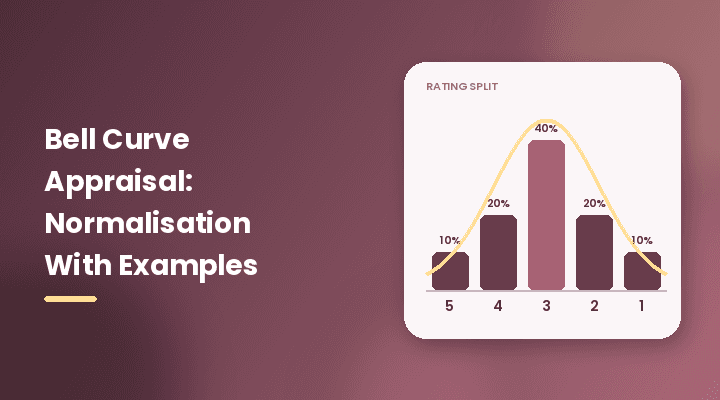
Bell curve appraisal is a way of fitting employees' performance ratings to a fixed distribution, for example 10% at the top rating, 20% above average, 40% average, 20% below average and 10% at the bottom. Before the quotas are applied, HR normalises each manager's raw scores so that a lenient rater and a strict rater can be compared on the same scale. The final ratings then feed increments, variable pay and promotions.
No Indian law prescribes or bans a rating curve. The law comes in at the point where a rating changes someone's pay or job, and that is where companies get into trouble: a low rating cannot cut the statutory bonus, and letting a "worker" go for a low rating without a misconduct finding is retrenchment under the Industrial Relations Code, 2020. This guide works through the quota arithmetic, z-score normalisation, the Excel formulas and those legal limits, with four worked examples.
Nothing here is legal advice. Law as at 17 November 2026: the four Labour Codes in force from 21 November 2025, with the central rules and Model Standing Orders notified in 2026.
| Bell curve appraisal at a glance | Rule or figure | Where it comes from |
|---|---|---|
| Rating split | No legal split. A common five-point policy is 10/20/40/20/10 | Company policy |
| Normalisation | z-score = (raw score minus team average) ÷ team standard deviation | Statistics; Excel STANDARDIZE |
| Rounding quotas | Write one method into the policy, such as largest remainder | Company policy |
| Statutory bonus | Minimum 8.33% of wages or ₹100, whichever is higher; a rating is not a ground to withhold it | Code on Wages, sections 26 and 29 |
| Performance incentives | Annual performance-based incentives are not "wages" for Labour Code calculations | Ministry of Labour FAQ 4 |
| Equal pay | No gender discrimination in wages for the same or similar work | Code on Wages, section 3 |
| Exiting a low-rated worker without a misconduct finding | Retrenchment | IR Code, section 2(zh) |
| Retrenchment conditions (one year's continuous service) | One month's written notice with reasons or wages in lieu, 15 days' average pay per completed year, notice to the government | IR Code, section 70 |
| Worker re-skilling fund | 15 days' last drawn wages, transferred within 10 days of retrenchment (central rules) | IR Code, section 83; IR (Central) Rules, rule 37 |
| Factory, mine or plantation with 300 or more workers | Three months' notice or wages in lieu, plus prior government permission | IR Code, sections 77 and 79 |
| Final wages on exit | Within two working days | Code on Wages, section 17(2) |
| Gratuity | 15 days' wages per completed year of service, after five years | Code on Social Security, section 53 |
What is bell curve appraisal?
The name comes from the normal distribution, the bell-shaped curve where most values sit near the average and fewer sit towards each end. Appraisal policies borrow the shape. The company decides in advance what share of people may receive each rating, and the ratings are then fitted to those shares.
Three terms get used as if they meant the same thing. They are separate steps, and a company can use one without the others:
| Term | What it means | Who does it |
|---|---|---|
| Forced distribution | Fixed quotas for each rating, such as 10/20/40/20/10, that every unit has to meet | Set by policy, enforced by HR |
| Normalisation | Adjusting raw scores so that a lenient manager's 4.4 and a strict manager's 3.6 can be compared | HR, with a formula or a ranking |
| Calibration | Managers meet, compare people across teams with evidence, and agree the final ratings | A committee, usually the function head and HR |
Many companies calibrate without forcing a distribution. A bell curve policy usually combines all three. The glossary entries on forced ranking and calibration cover the debate about each.
Which rating distributions do companies use?
Because no law sets a split, every version below is a policy choice:
| Model | Split | Typical use |
|---|---|---|
| Five-point | 10 / 20 / 40 / 20 / 10 | A 1 to 5 rating scale |
| Three-bucket | 10 / 80 / 10 | High, solid and low performers, with most people in the middle |
| 20-70-10 | 20% top, 70% middle, 10% bottom | The split GE described in its 2000 annual report letter |
| Guideline with tolerance | For example, top 15% to 25%, bottom 5% to 10% | Units can deviate with a written reason |
Policies sometimes cite the 68-95-99.7 rule, which is a different thing. It says that in a normal distribution about 68% of values fall within one standard deviation of the average, about 95% within two and about 99.7% within three. It describes how data spreads and says nothing about how many people should get each rating. If scores really were normal, a 10/20/40/20/10 split would put the rating cut-offs at roughly 0.52 and 1.28 standard deviations either side of the average. The rule can describe a split once you have chosen it, but it gives no reason to prefer one split over another.
Worked example 1: quotas for a 47-person department
A 10/20/40/20/10 policy applied to 47 people gives 4.7, 9.4, 18.8, 9.4 and 4.7. Nobody can be rated as 0.7 of a person, so the policy has to say how the decimals are handled. Two common methods give different answers:
| Rating | Exact | Largest remainder | Tails rounded down |
|---|---|---|---|
| 5 (top) | 4.7 | 5 | 4 |
| 4 | 9.4 | 9 | 9 |
| 3 | 18.8 | 19 | 21 |
| 2 | 9.4 | 9 | 9 |
| 1 (bottom) | 4.7 | 5 | 4 |
| Total | 47 | 47 | 47 |
Largest remainder first takes the whole number in each bucket (4, 9, 18, 9 and 4, which is 44 people) and then hands the three leftover places to the buckets with the biggest decimals: 0.8 in the middle and 0.7 at each end. Tails rounded down takes the whole number in every bucket except the middle and puts everyone left over into the middle. It gives one fewer person a "1" and one fewer person a "5", and that is the usual argument for it. Write the method into the policy before the cycle starts, including how to break a tie between two equal decimals, or each department will argue for the rounding that suits it.
Small groups make the problem much worse. On 12 people the exact shares are 1.2, 2.4, 4.8, 2.4 and 1.2. Tails rounded down gives 1 / 2 / 6 / 2 / 1. Largest remainder gives the middle bucket one extra place and then has a tie between the 4 and 2 buckets at 0.4 each. On 9 people, tails rounded down gives 0 / 1 / 7 / 1 / 0 and largest remainder gives 1 / 2 / 3 / 2 / 1, two very different outcomes for the same team. This is one reason to apply quotas to a whole department or function, with 40 or more people as a working rule.
Worked example 2: z-score normalisation of two managers
Ritu manages six people and rates generously. Sanjay manages six people and rates hard. Their raw scores on a 1 to 5 scale, and each person's z-score within their own team:
| Ritu's team | Raw | z-score | Sanjay's team | Raw | z-score |
|---|---|---|---|---|---|
| Asha | 4.6 | 1.43 | Gaurav | 4.0 | 1.54 |
| Bilal | 4.4 | 0.77 | Hema | 3.6 | 0.72 |
| Chitra | 4.3 | 0.44 | Imran | 3.4 | 0.31 |
| Deepak | 4.1 | -0.22 | Jaya | 3.1 | -0.31 |
| Esha | 3.9 | -0.88 | Kiran | 2.9 | -0.72 |
| Farhan | 3.7 | -1.54 | Lalit | 2.5 | -1.54 |
Ritu's team averages 4.17 with a standard deviation of 0.30. Sanjay's averages 3.25 with a standard deviation of 0.49. Both are population standard deviations. The z-score is (raw score minus team average) ÷ team standard deviation, and it shows how far each person sits from their own manager's norm. Asha's 4.6, for example, is (4.6 minus 4.17) ÷ 0.30, or about 1.43.
Merge the 12 people, sort them by z-score and apply the 1 / 2 / 6 / 2 / 1 quota that tails-down rounding gives for 12 people in example 1:
- Rating 5: Gaurav (1.54). Sanjay's 4.0 now ranks above Ritu's 4.6.
- Rating 4: Asha (1.43) and Bilal (0.77).
- Rating 3: Hema, Chitra, Imran, Deepak, Jaya and Kiran.
- Rating 2: Esha (-0.88) and Farhan (-1.537).
- Rating 1: Lalit (-1.544).
Look at the last two rows. Farhan and Lalit both show -1.54 to two decimals, and the formula separates them by 0.007. A gap that small should go to the calibration meeting, which decides on evidence such as goals met, customer escalations and attendance. The method also assumes both teams are equally strong underneath. If Ritu really does have the stronger team, z-scores push her people down, so that question belongs in calibration too.
How do you calculate bell curve ratings in Excel?
With names in column A and raw scores in column B, and Ritu's team in rows 2 to 7 and Sanjay's in rows 8 to 13, these formulas reproduce example 2. We tested them in a spreadsheet against the figures above.
| Step | Formula (first row) | What it returns |
|---|---|---|
| z-score within Ritu's team | =STANDARDIZE(B2,AVERAGE($B$2:$B$7),STDEV.P($B$2:$B$7)) | 1.43 for Asha |
| z-score within Sanjay's team | =STANDARDIZE(B8,AVERAGE($B$8:$B$13),STDEV.P($B$8:$B$13)) | 1.54 for Gaurav |
| Rank across both teams | =RANK.EQ(C2,$C$2:$C$13,0) | 1 for Gaurav, 12 for Lalit |
| Percentile in the merged list | =PERCENTRANK.INC($C$2:$C$13,C2) | 1 for Gaurav, 0 for Lalit |
| Rating from rank, for a 1/2/6/2/1 quota | =IF(D2<=1,5,IF(D2<=3,4,IF(D2<=9,3,IF(D2<=11,2,1)))) | 5 for Gaurav, 1 for Lalit |
| Whole number in a bucket, for largest remainder | =ROUNDDOWN(47*10%,0) | 4 |
Use the same standard deviation function for every team. STDEV.S divides by one less than the team size, so it gives slightly smaller z-scores than STDEV.P (Farhan's would be -1.40), and mixing the two changes the merged order. RANK.EQ gives tied scores the same rank, so settle ties before applying the rating formula. PERCENTRANK.INC truncates its result to three significant digits by default, which is why the rank is the safer column for filling exact quotas.
Worked example 3: does the bonus pool still balance?
A 40-person sales and service unit has target variable pay of ₹1,20,000 a person, so the pool at target is ₹48 lakh. The multipliers by rating are 1.5 for a 5, 1.2 for a 4, 1.0 for a 3, 0.6 for a 2 and nil for a 1.
| Distribution | Headcount by rating (5 to 1) | Average multiplier | Payout |
|---|---|---|---|
| Policy curve 10/20/40/20/10 | 4 / 8 / 16 / 8 / 4 | 0.91 | ₹43.68 lakh |
| Managers' ratings before normalisation, 15/35/35/10/5 | 6 / 14 / 14 / 4 / 2 | 1.055 | ₹50.64 lakh |
The policy curve gives (4 × 1.5 + 8 × 1.2 + 16 × 1.0 + 8 × 0.6) ÷ 40 = 0.91. The managers' ratings give (6 × 1.5 + 14 × 1.2 + 14 × 1.0 + 4 × 0.6) ÷ 40 = 1.055. Left as they are, the managers' ratings pay ₹2.64 lakh more than the ₹48 lakh pool and ₹6.96 lakh more than the policy curve. This is the budget argument for keeping some form of curve. Notice also that with these multipliers the policy curve itself pays only 91% of target. If the pool is meant to be paid out in full when ratings follow the curve, set the multipliers so that the curve averages 1.0. The same arithmetic applies to the increment budget, where the final rating feeds a merit matrix.
Is the bell curve legal in India?
Yes. No central statute requires or bans a rating distribution. The legal questions arise from what the company does with a rating, and the biggest one is exit.
Retrenchment. Section 2(zh) of the Industrial Relations Code, 2020 defines retrenchment as the termination of a worker's service by the employer "for any reason whatsoever, otherwise than as a punishment inflicted by way of disciplinary action". The exclusions are voluntary retirement, superannuation, non-renewal or contractual termination of a contract of employment, completion of a fixed term, and continued ill-health. Poor performance is not among them. So releasing the bottom 10% of workers on rating alone, without a disciplinary finding, is retrenchment.
Who is a worker. Under section 2(zr), a worker is a person employed to do manual, unskilled, skilled, technical, operational, clerical or supervisory work. It does not include people employed mainly in a managerial or administrative capacity, or people in a supervisory capacity drawing wages above ₹18,000 a month (or a higher amount if the Central Government notifies one). The Ministry of Labour's FAQ compilation as on 25 October 2026 still states the ₹18,000 figure. The test turns on the actual duties, so a job title alone does not settle it.
What the IR Code requires. For a worker with at least one year's continuous service (section 66 also counts a worker who actually worked at least 240 days in the preceding 12 months, outside mines):
| Requirement | Rule | Where |
|---|---|---|
| Notice | One month's notice in writing giving the reasons, or wages for the notice period in lieu | Section 70(a) |
| Compensation | 15 days' average pay for every completed year of continuous service or part of a year over six months, paid at the time of retrenchment | Section 70(b) |
| Notice to the government | In Form XIII, within three days of the notice or of paying wages in lieu (central sphere) | Section 70(c); IR (Central) Rules, rule 27 |
| Order of retrenchment | Ordinarily the last person employed in that category goes first, unless the employer records reasons for choosing someone else | Section 71 |
| Re-employment | Retrenched workers get preference if the employer hires within one year | Section 72 |
| Re-skilling fund | 15 days' last drawn wages per retrenched worker, transferred to the fund within 10 days; the worker's account is credited within 45 days | Section 83; IR (Central) Rules, rule 37 |
| Larger industrial establishments | A factory, mine or plantation with 300 or more workers needs three months' notice or wages in lieu and prior government permission | Sections 77 and 79 |
Section 71 matters most here. A rating-based exit departs from the last-in, first-out order, so the reasons have to be recorded at the time. Record the evidence behind the rating, such as missed goals and the support offered, along with the rank itself.
Misconduct and standing orders. Industrial establishments with 300 or more workers must have standing orders (section 28), and the First Schedule requires them to list the acts that amount to misconduct. The Model Standing Orders, 2026 list "habitual neglect of work" and "malingering or slowing down work" among them. A low rating is not misconduct on its own. Whether persistent under-performance can be charged as habitual neglect depends on the facts and on a proper inquiry under the standing orders, and this is contested ground. Take advice before treating a rating as a disciplinary matter.
Managers and supervisors above the threshold. They are not workers, so sections 70 to 83 do not protect them. Their exit is governed by the employment contract and the state's shops and establishments law. Some states require a reasonable cause and a month's notice after six months of continuous service, and some exclude people in management positions from the Act altogether. Our probation period rules guide has a state-by-state table, and the retrenchment glossary entry covers the definition in more depth.
Can a low rating reduce statutory bonus, gratuity or PF?
Statutory bonus. Section 26 of the Code on Wages requires a minimum bonus of 8.33% of wages earned, or ₹100 if that is higher, for employees drawing wages up to the notified ceiling who have worked at least 30 days in the accounting year. Where the allocable surplus allows more, bonus is in proportion to wages earned, up to 20%. Section 29 disqualifies only an employee dismissed for fraud, riotous or violent behaviour on the premises, theft, misappropriation or sabotage of the establishment's property, or conviction for sexual harassment. A rating of 1 is not on that list. Ratings can drive a performance bonus, but the statutory bonus has to be paid on wages. Our bonus calculation guide covers the ceiling and the arithmetic.
Performance pay and "wages". The Ministry of Labour's FAQ compilation (question 4) says annual performance-based incentives do not form part of "wages" for calculations under the Labour Codes. A rating-linked annual incentive therefore does not normally change the PF, gratuity or bonus base. A fixed allowance that the rating decides is a different case, so check how each component is defined.
Equal pay. Section 3 of the Code on Wages bars discrimination on the ground of gender in matters relating to wages for the same or similar work. If women in a unit cluster at the bottom of the curve and that drives smaller increments, review the evidence before the letters go out.
Worked example 4: the cost of retrenching a bottom-rated worker
Prakash is a production technician in a 180-worker factory. He is a "worker" under the IR Code, earns wages of ₹17,600 a month, has 6 years and 8 months of continuous service and has been rated 1 twice. The company decides to let him go without a misconduct finding, so the exit is retrenchment. The factory has fewer than 300 workers, so prior permission is not needed. Using the 26-working-day convention, a day's wage is ₹17,600 ÷ 26 = ₹676.92.
| Item | Working | Amount |
|---|---|---|
| Wages in lieu of one month's notice | 1 month | ₹17,600 |
| Retrenchment compensation | 7 years × 15 days × ₹676.92 | ₹71,077 |
| Re-skilling fund contribution | 15 days × ₹676.92 | ₹10,154 |
| Gratuity | 7 × 15 ÷ 26 × ₹17,600 | ₹71,077 |
| Total, before leave encashment and final wages | ₹1,69,908 |
The 8 months beyond 6 years is more than six months, so it counts as a seventh year for both compensation and gratuity. Compensation is on "average pay", the average of the last three complete months' wages; here wages were the same each month. The 26-day divisor is the usual convention for gratuity and is commonly used for retrenchment compensation as well. Some employers divide by 30 for compensation, which gives ₹61,600, so confirm the basis with your adviser. Gratuity is payable because the service is over five years and the Code on Social Security treats any termination other than superannuation as retirement; our gratuity calculation guide covers the formula. Final wages are due within two working days of the exit, as our full and final settlement guide explains, and the gratuity calculator checks the gratuity figure.
Put this figure in front of the leadership team before anyone proposes a bottom-10% exit. A performance improvement plan with documented support is usually cheaper, and it leaves a record that stands up better if the exit is disputed.
How do you run a bell curve cycle step by step?
- Write the policy first. Cover the rating scale, the split, the level at which quotas apply (department or function), the rounding and tie-break rules, any tolerance band and who signs off deviations.
- Close goals and evidence. Ratings should rest on goals set at the start of the year and evidence from the whole year.
- Collect raw manager ratings. Ask for a one-line justification for every top and bottom rating.
- Normalise. Where a pool has several raters, convert scores to z-scores or ranks within each manager's team.
- Calibrate. The function head and HR go through borderline cases and near-ties and record the reasons for each decision.
- Run fairness checks. Look at outcomes by gender and location, and for people who were on maternity or long medical leave during the year.
- Lock ratings and map them to pay. Apply the merit matrix and bonus multipliers, then check the totals against budget.
- Communicate. Managers explain each rating with the evidence behind it.
- Handle the bottom bucket through a process. Use feedback, a performance improvement plan and documented support. Any exit follows the IR Code for workers, or the contract and state law for others.
- Keep the record. Store raw scores, normalised scores, calibration notes and approvals for as long as a dispute could arise.
What are the common bell curve mistakes?
- Applying quotas to teams of five or six. Someone lands in the bottom rating because of the arithmetic.
- Treating the curve as an exit list. For workers, that is retrenchment, with notice, compensation, the re-skilling contribution and the last-in, first-out rule.
- Having no rounding rule. Each department then rounds in its own favour.
- Comparing part-year joiners with full-year performers. Decide whether new joiners are rated in their first cycle, and how.
- Rating people on maternity leave against full-year output. Rate the period worked, or exclude them by policy.
- Linking statutory bonus to the rating. Only a performance bonus can move with the rating.
- Losing the paper trail. Ratings kept in a chat group and a spreadsheet on one laptop are hard to defend before a conciliation officer.
Bell curve appraisal FAQs
What is bell curve appraisal?
It is a method that fits employee ratings to a set distribution, such as 10/20/40/20/10 or 20-70-10, with most people in the middle rating and fewer at each end. It is usually combined with normalisation of each manager's scores and a calibration meeting.
What is normalisation in performance appraisal?
Normalisation adjusts raw ratings so that scores from lenient and strict managers can be compared. The usual method converts each score to a z-score, which is (score minus team average) ÷ team standard deviation, and then ranks everyone together.
How do I calculate a bell curve appraisal in Excel?
Use =STANDARDIZE(score, AVERAGE(range), STDEV.P(range)) within each manager's team. Then rank the merged list with RANK.EQ and assign ratings from the quota counts, rounded by the rule in your policy.
What is the 20-70-10 rule?
It is the split GE described in its 2000 annual report letter: the top 20%, a high-performance middle 70% and a bottom 10% that the company aimed to remove each year. In India, removing a worker on that basis without a misconduct finding is retrenchment under the IR Code.
Can a company terminate employees rated in the bottom 10% in India?
Not on the rank alone. For a worker with a year's service it is retrenchment: one month's notice or wages in lieu, 15 days' average pay per completed year, 15 days' wages to the re-skilling fund and notice to the government. A factory, mine or plantation with 300 or more workers also needs three months' notice and prior permission. For managers, the contract and the state shops and establishments law apply.
Can a low rating reduce statutory bonus?
No. The Code on Wages disqualifies an employee from bonus only on dismissal for fraud, violent behaviour on the premises, theft, misappropriation or sabotage, or conviction for sexual harassment. A performance bonus can follow the rating.
Is the bell curve fair for small teams?
Rarely. With fewer than about 15 to 20 people, the quotas swing by a whole person on rounding. Apply the curve at department level, or use guideline ranges with written exceptions.
How does Engage help with appraisal cycles?
A bell curve cycle run in spreadsheets means a dozen manager sheets, a merge and formulas that break when someone inserts a row. After that, someone retypes the final ratings into the increment sheet, and any slip shows up in a payslip.
Engage performance management, built for companies with 50 or more employees, runs goal setting with cascading OKRs and KPIs, rule-based KPI scoring and configurable review cycles with self, peer and manager assessments. Appraisal outcomes and KPI scores link directly to increments, bonuses and promotions, and Engage payroll uses appraisal and goal outcomes for increments, incentives and variable pay each cycle. Payroll access is role-based, and every change to a payroll record goes into an audit trail with the user and timestamp.
For the definitions behind a review cycle, see the glossary entries on appraisal and performance management systems.
To see what it would cost for your team size, check Engage pricing.
Sources
- Industrial Relations Code, 2020. Ministry of Labour and Employment. Sections 2(zh) and 2(zr); 28 and the First Schedule on standing orders; 66 on continuous service; 70 to 72 on retrenchment; 77 and 79 on larger industrial establishments; 83 on the re-skilling fund.
- Industrial Relations (Central) Rules, 2026. G.S.R. 342(E), 8 May 2026. Rule 27 on the retrenchment notice in Form XIII; rule 37 on the re-skilling fund.
- Model Standing Orders, 2026. S.O. 2312(E), 8 May 2026. The list of acts of misconduct in Schedules A to C.
- Code on Wages, 2019. Section 3 on gender discrimination in wages; section 17(2) on wages at exit; sections 26 and 29 on bonus.
- Code on Social Security, 2020. Section 2(70) on retirement; section 53 on gratuity.
- Ministry of Labour and Employment, Compilation of FAQs on Four Labour Codes and Central Rules (as on 25 October 2026). Question 4 on performance-based incentives; question 154 on the definition of worker.
- Press Information Bureau, "Government Makes the Four Labour Codes effective to Simplify and Streamline Labour Laws", 21 November 2025. Commencement of the four Codes.