
A payroll journal entry records the month's salary cost and everything the company now owes because of it. In India you debit salary expense with gross pay, then credit net salary payable and a separate liability for each deduction: employee PF, employee ESI, professional tax and TDS under section 392 of the Income-tax Act, 2025. A second entry books the employer's PF, EDLI, PF admin charges and employer ESI. Both entries are posted on the last day of the wage month, and every liability they create should be back at zero once the salary, the TDS and the challans are paid.
Law as at 18 November 2026: the Labour Codes in force since 21 November 2025, the ₹25,000 PF wage ceiling in force since 17 September 2026, and the Income-tax Act, 2025 for salary paid from 1 April 2026. Nothing here is legal, tax or accounting advice.
| Item | Rule | Where it comes from |
|---|---|---|
| Monthly salary | Paid before the 7th day of the next month ends | Code on Wages, 2019, s.17(1)(iv) |
| Final wages on resignation, removal or retrenchment | Within two working days | Code on Wages, 2019, s.17(2) |
| TDS on salary | Deducted under s.392, deposited by the 7th of the next month (30 April for March) | Income-tax Act, 2025, s.392; Income-tax Rules, 2026, rule 218(2) |
| PF wage ceiling | ₹25,000 a month from 17 September 2026 (₹15,000 before) | Code on Social Security, 2020, s.2(89); S.O. 5109(E) |
| Wages for PF and ESI | Basic, DA and retaining allowance, plus excluded items above 50% of pay | Code on Social Security, 2020, s.2(88) |
| ESI | 0.75% employee, 3.25% employer, wages up to ₹21,000; due within 15 days of month end | ESIC; MoLE FAQ Q114 and Q123 |
| PF deposit | By the 15th of the next month, through the ECR | EPFO |
| Gratuity | 15 days' wages per completed year; paid within 30 days | Code on Social Security, 2020, s.53(2) and s.56(3) |
| Statutory bonus | At least 8⅓%; paid within eight months of the year end | Code on Wages, 2019, s.26 and s.39 |
What is a payroll journal entry?
A payroll journal entry, often called the salary JV, is the accounting record of one payroll run. The payroll register says what each employee earned and what was deducted. The journal rolls those figures into ledgers so the profit and loss account shows the full cost of people and the balance sheet shows what you owe to employees, EPFO, ESIC, the state and the Income Tax Department.
Three terms come up throughout:
- Gross salary is total earnings before deductions: basic, DA, HRA, allowances, overtime and arrears. This is the expense.
- Net pay, or salary payable, is what reaches the employee's bank account. It is a liability until it is paid.
- Statutory payables are amounts you deducted, or owe on top of salary, and hold until you deposit them: PF, ESI, professional tax, LWF and TDS payable.
The employee's share of PF or ESI is not a company expense. It is part of gross salary, which you have already expensed, and the company only holds it until the challan is paid. The employer's share is an extra cost on top of gross salary. In Schedule III accounts both sit under "Employee benefits expense", the employer share as contribution to provident and other funds. Mixing the two shares is the usual reason a salary JV and a PF challan refuse to agree.
Which ledgers does a payroll journal need?
Set these up once in Tally, Zoho Books or your ERP. Separate ledgers for the employee and employer shares look fussy, but they are what let you match the books to the ECR and the ESI challan each month.
| Ledger | Type | Typical group | What goes in |
|---|---|---|---|
| Salaries and wages | Expense | Employee benefits expense | Gross earnings of all employees |
| Employer contribution to PF | Expense | Employee benefits expense | Employer 12%, split into EPS 8.33% and EPF 3.67% |
| PF admin and EDLI charges | Expense | Employee benefits expense | 0.5% admin and 0.5% EDLI on PF wages |
| Employer contribution to ESI | Expense | Employee benefits expense | 3.25% of ESI wages for covered employees |
| Bonus, gratuity, leave encashment | Expense | Employee benefits expense | Monthly provisions |
| Salary payable | Liability | Current liabilities | Net pay due to employees |
| PF payable, employee share and employer share | Liability | Current liabilities | Cleared by the ECR challan |
| ESI payable, employee share and employer share | Liability | Current liabilities | Cleared by the ESIC challan |
| Professional tax payable, LWF payable | Liability | Duties and taxes | Cleared on each state's schedule |
| TDS payable, salary (s.392) | Liability | Duties and taxes | Cleared by the TDS challan |
| Provision for bonus, gratuity, leave encashment | Liability | Provisions | Built monthly, used on payment |
| Salary advances and employee loans | Asset | Loans and advances | Reduced by each instalment recovered from salary |
If you still have a ledger called "TDS payable u/s 192", rename it. Salary paid from 1 April 2026 falls under section 392 of the Income-tax Act, 2025, as our old and new TDS sections map shows. Keep the old ledger only until any March 2026 balance is cleared.
What are the five payroll journal entries every month?
| # | Entry | Debit | Credit | When |
|---|---|---|---|---|
| 1 | Salary accrual | Salaries and wages (gross) | Salary payable (net); PF payable, employee; ESI payable, employee; PT payable; LWF payable (when due); TDS payable; Salary advances (recovery) | Last day of the wage month |
| 2 | Employer contributions | Employer contribution to PF; PF admin and EDLI charges; Employer contribution to ESI | PF payable, employer; ESI payable, employer | Same day as entry 1 |
| 3 | Net salary paid | Salary payable | Bank | Before the 7th of the next month ends |
| 4 | TDS deposited | TDS payable | Bank | By the 7th (30 April for March) |
| 5 | PF, ESI, PT and LWF deposited | Each payable | Bank | PF and ESI by the 15th; PT and LWF on the state schedule |
The pay date in entry 3 is a legal deadline. Section 17(1)(iv) of the Code on Wages, 2019 requires monthly wages to be paid before the expiry of the seventh day of the following month, and section 17(2) requires wages to be paid within two working days when an employee resigns, is removed, dismissed or retrenched. The TDS date comes from rule 218(2) of the Income-tax Rules, 2026. ESIC's rule is 15 days from the last day of the month, and the PF ECR is due by the 15th as well. Our statutory compliance calendar for 2026-27 lists every date.
Worked example 1: salary journal entry with PF, ESI, PT and TDS
Take an Ahmedabad trading company with 150 employees, closing its October 2026 payroll. The figures are illustrative.
- 60 warehouse staff earn ₹20,000 gross each: basic and DA ₹14,000, HRA ₹4,000 and conveyance allowance ₹2,000. HRA and conveyance are excluded from wages under section 2(88) and come to less than half of pay, so their wages for PF and ESI are ₹14,000. That clears the Gujarat minimum wage for unskilled and semi-skilled shop work in Zone I from 1 October 2026. They are within the ₹21,000 ESI ceiling and pay ₹200 Gujarat professional tax, because they earn above ₹12,000.
- 90 office staff earn ₹65,000 gross each, with basic of ₹32,500. Their PF is restricted to the ₹25,000 ceiling. They are outside ESI and pay ₹200 professional tax. To keep the example short, all of them are members of the pension scheme.
- TDS worked out from each employee's projected annual tax comes to ₹1,85,000 this month. Many staff under the new regime have nil TDS.
- Eight employees repay salary advance instalments of ₹5,000 each.
Rates used: PF 12% from the employee and 12% from the employer, of which 8.33% goes to EPS and the rest to EPF; EDLI 0.5% and admin charges 0.5%, all on PF wages up to ₹25,000. ESI is 0.75% from the employee and 3.25% from the employer. Our PF calculation guide and ESI calculation guide go through each rate.
One change to watch on ESI. The Ministry of Labour's FAQ on the Codes (Q97 and Q123) says that from 21 November 2025 ESI contributions are payable on wages as defined in section 2(88) of the Code on Social Security instead of on gross pay. For the warehouse staff that base is ₹14,000. On the old gross basis it would have been ₹20,000, and the employee share would be ₹150 instead of ₹105. Check which base your payroll uses.
Per-employee working
| Item | Warehouse (x60) | Office (x90) |
|---|---|---|
| Gross salary | ₹20,000 | ₹65,000 |
| PF wages | ₹14,000 | ₹25,000 (capped) |
| Employee PF 12% | ₹1,680 | ₹3,000 |
| Employer EPS 8.33% | ₹1,166 | ₹2,083 |
| Employer EPF (12% less EPS) | ₹514 | ₹917 |
| EDLI 0.5% and admin 0.5% | ₹70 and ₹70 | ₹125 and ₹125 |
| Employee ESI 0.75% | ₹105 | Nil |
| Employer ESI 3.25% | ₹455 | Nil |
| Professional tax | ₹200 | ₹200 |
EPS at the ceiling is 8.33% of ₹25,000, which is ₹2,082.50, rounded to ₹2,083. That is the maximum EPFO gives for the new ceiling. For an office employee outside the pension scheme, the whole employer 12% goes to EPF, so the total is the same and only the split changes.
Entry 1, salary accrual (31 October 2026)
| Account | Debit (₹) | Credit (₹) |
|---|---|---|
| Salaries and wages | 70,50,000 | |
| To PF payable, employee share | 3,70,800 | |
| To ESI payable, employee share | 6,300 | |
| To Professional tax payable | 30,000 | |
| To TDS payable, salary (s.392) | 1,85,000 | |
| To Salary advances | 40,000 | |
| To Salary payable | 64,17,900 | |
| Total | 70,50,000 | 70,50,000 |
Entry 2, employer contributions (31 October 2026)
| Account | Debit (₹) | Credit (₹) |
|---|---|---|
| Employer contribution to PF (EPS 2,57,430 and EPF 1,13,370) | 3,70,800 | |
| PF admin and EDLI charges (15,450 and 15,450) | 30,900 | |
| Employer contribution to ESI | 27,300 | |
| To PF payable, employer share | 4,01,700 | |
| To ESI payable, employer share | 27,300 | |
| Total | 4,29,000 | 4,29,000 |
Entries 3 to 5, payments in November
| Date (by) | Debit | Credit | ₹ |
|---|---|---|---|
| 7 November | Salary payable | Bank | 64,17,900 |
| 7 November | TDS payable, salary | Bank | 1,85,000 |
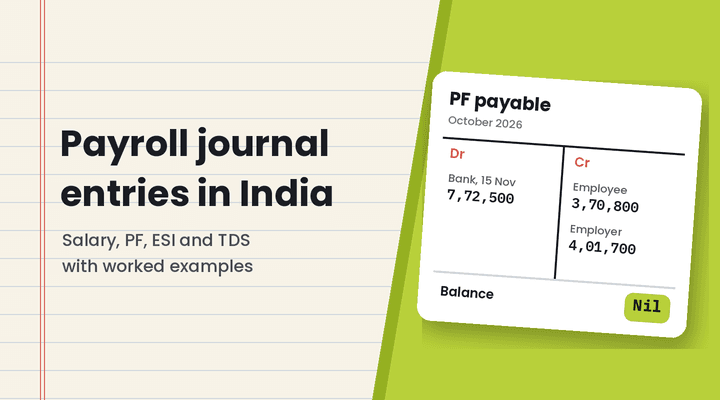
| 15 November | PF payable, employee 3,70,800 and employer 4,01,700 | Bank | 7,72,500 |
| 15 November | ESI payable, employee 6,300 and employer 27,300 | Bank | 33,600 |
| 15 November | Professional tax payable | Bank | 30,000 |
Two checks are worth running every month. First, October's cost to company is ₹74,79,000: gross of ₹70,50,000 plus employer cost of ₹4,29,000. That should match the CTC report. Second, the ₹7,72,500 PF challan should equal the ECR total to the rupee, and once it is paid both PF payable ledgers should show zero.
Professional tax and LWF dates differ by state. Gujarat professional tax is due by the 15th of the following month, and Gujarat LWF is deducted only in June and December, so October has no LWF line. Look up your own state on our professional tax and LWF pages.
Worked example 2: journal entry for full and final settlement
Full and final settlement is where the books most often go wrong, because one voucher mixes salary, provisions, recoveries and tax. It also has a two-working-day payment deadline under section 17(2) of the Code on Wages, which our full and final settlement guide covers.
Priya, a team lead in the same company, resigns with 31 October 2026 as her last day. Her monthly gross is ₹80,000 and her basic is ₹40,000, with allowances making up the other half. She has six completed years of service.
- October salary: ₹80,000 gross. Employee PF is ₹3,000 on the ₹25,000 ceiling and professional tax is ₹200.
- Leave encashment: 12 days at basic divided by 30, under company policy, gives ₹16,000, already held in the leave encashment provision.
- Gratuity: 15/26 x ₹40,000 x 6 gives ₹1,38,462. The provision for Priya holds ₹1,30,000, so ₹8,462 is a fresh expense. Section 53(2) of the Code on Social Security sets 15 days' wages for each completed year; dividing the monthly wage by 26 is the long-standing convention for monthly-rated staff. The method is in our gratuity calculation guide.
- Notice shortfall: she served 45 of 60 days. Recovery for 15 days at gross divided by 30 is ₹40,000, if her contract provides for it (see notice period recovery).
- Outstanding salary advance: ₹10,000.
- TDS on the settlement after exemptions: ₹6,000, for illustration.
Full and final settlement entry (31 October 2026)
| Account | Debit (₹) | Credit (₹) |
|---|---|---|
| Salaries and wages | 80,000 | |
| Provision for leave encashment | 16,000 | |
| Provision for gratuity | 1,30,000 | |
| Gratuity expense (shortfall over provision) | 8,462 | |
| To Notice pay recovery (other income) | 40,000 | |
| To Salary advances | 10,000 | |
| To PF payable, employee share | 3,000 | |
| To Professional tax payable | 200 | |
| To TDS payable, salary (s.392) | 6,000 | |
| To F&F payable, Priya | 1,75,262 | |
| Total | 2,34,462 | 2,34,462 |
The employer PF on her October wages (₹2,083 EPS, ₹917 EPF, ₹125 EDLI and ₹125 admin) goes through the normal entry 2. 31 October 2026 is a Saturday, so on a Monday to Friday week the two working days run out on Tuesday 3 November. When the ₹1,75,262 is paid, debit F&F payable and credit Bank. Gratuity has its own outer limit of 30 days under section 56(3) of the Code on Social Security, but most employers pay it with the rest of the settlement.
Two points practitioners trip on. If gratuity is funded through an insurer's group gratuity scheme, the payout comes from the fund. The fund balance is an asset, so the payout reduces that asset and the provision, and the actuary's report sets the year-end true-up. Second, notice pay recovery is income and belongs in its own ledger. Booking it against salary understates people cost. The GST treatment of notice pay recovery has been argued both ways, so take your CA's view before you settle on one.
Which payroll provisions and accruals should you book at month-end?
The salary JV covers what was paid. Accrual accounting also needs the cost that has been earned but not yet paid, booked monthly so March does not carry a year of catch-up.
| Provision | Monthly entry | Basis |
|---|---|---|
| Statutory bonus | Dr Bonus expense, Cr Provision for bonus | At least 8⅓% of the calculation wage for eligible staff |
| Gratuity | Dr Gratuity expense, Cr Provision for gratuity | Actuarial valuation under Ind AS 19 or AS 15, spread monthly |
| Leave encashment | Dr Leave encashment expense, Cr Provision for leave encashment | Leave balance x encashment rate, or actuarial |
| Variable pay or incentive | Dr Incentive expense, Cr Provision for incentive | Best estimate, trued up when paid |
| Overtime or arrears paid next month | Dr Salaries and wages, Cr Salary payable (accrued) | Attendance data for the month |
A bonus example. The 60 warehouse staff in example 1 earn wages of ₹14,000, inside the ₹21,000 eligibility limit used in the Central sphere. Under section 26(2) of the Code on Wages, a wage above the notified calculation amount (₹7,000 in the Central sphere) is treated as that amount or the applicable minimum wage, whichever is higher. Take the minimum wage as ₹13,637, the Zone I unskilled rate for Gujarat shops. 8⅓% is one-twelfth, so the minimum bonus is ₹13,637 a year per employee and the monthly provision is 60 x ₹13,637 / 12 = ₹68,185, or ₹8,18,220 for the year. Use your own state's notified figures, which our bonus calculation guide sets out. When the bonus is paid, within eight months of the year end under section 39 (30 November for an April to March year), debit the provision and credit Bank and TDS payable. No second expense is booked.
If you accrue an estimate, overtime for instance, and the actual figure arrives next month, reverse the estimate on the 1st and book the actual. Leaving both in place counts the cost twice.
How do you post a salary journal entry in Tally Prime or Zoho Books?
In Tally Prime:
- Create the ledgers from the table above. Salary and employer contributions go under Indirect Expenses, or Direct Expenses for factory wages if that is how you report. PF, ESI and salary payable go under Current Liabilities, TDS and professional tax under Duties & Taxes, provisions under Provisions and salary advances under Loans & Advances (Asset).
- Open Vouchers and press F7 for a Journal voucher dated the last day of the wage month.
- Enter the debits and credits for entry 1, then entry 2, as in example 1. Add cost centres (department, plant or project) if you track people cost by unit.
- Write a narration such as "Salary for October 2026 as per payroll register, 150 employees" and reference the register.
- Use Payment vouchers (F5) for the salary transfer and each challan.
In Zoho Books the same two entries go in as manual journals, with the payments recorded against the bank account. Any ERP follows the same structure. If your payroll software exports a ready journal, check that its ledger names match your chart of accounts before the first import.
Payroll journal checklist: month-end, step by step
- Lock the payroll register. Attendance, loss of pay, overtime, arrears, joiners and leavers are final and the register is approved.
- Pull the summary by component and cost centre: gross, each deduction, each employer contribution and net pay.
- Post entry 1 on the last day of the month. Confirm debits equal credits and net pay equals the bank file total.
- Post entry 2. Recompute PF on PF wages with the ₹25,000 cap where your policy uses it, and ESI on section 2(88) wages for covered staff only.
- Post provisions for bonus, gratuity, leave encashment, incentives and accrued overtime.
- Pay salaries before the 7th ends, and final wages within two working days of an exit.
- Deposit TDS by the 7th (30 April for March), PF and ESI by the 15th, and PT and LWF on the state schedule.
- Reconcile every payable to zero. PF payable should equal the ECR, ESI payable the ESIC challan, and TDS payable the challans and the quarterly Form 138, which replaces Form 24Q from tax year 2026-27. Investigate any balance left over.
- Reconcile salary advances with the loan schedule so each employee's balance matches the ledger (see salary advance recovery).
- File the evidence: register, JV, challans and bank statement line, so an auditor can trace one rupee from end to end. Our payroll reconciliation entry lists the comparisons.
Common mistakes in payroll journal entries
- Expensing net pay instead of gross. If you book only the bank transfer, the TDS, PF and PT you deducted disappear from the books and cost is understated.
- One PF ledger for both shares. It balances at month-end and still hides errors. When EPFO flags a shortfall, you cannot tell which side is short.
- Computing PF on gross salary. PF runs on wages under section 2(88): basic, DA and retaining allowance, plus any excess of excluded items over half of pay. HRA and conveyance are excluded. A special allowance is not on the excluded list, so it counts as wages.
- Splitting September 2026 wrongly. The ceiling changed on 17 September, so EPFO treats 1 to 16 September at ₹15,000 and 17 to 30 September at ₹25,000, reported in one ECR. If your September journal used one ceiling for the whole month, revisit it.
- Treating a salary advance as an expense. An advance is an asset when paid and is reduced as instalments are recovered. Expensing it inflates that month's cost and leaves nothing to recover against.
- Paying gratuity from expense while the provision sits untouched. The cost is then booked twice, once when provided and again when paid.
- Netting notice recovery against salary, which hides both the real people cost and the recovery income.
- Booking interest on late TDS or PF damages to salary. Keep it in a separate interest or penalty ledger where management can see it.
- Old section labels. A ledger still named "192" after 1 April 2026 confuses auditors and the team filing Form 138.
How payroll software helps with journal entries
Most of the errors above start with someone retyping register totals into the accounting system. When the journal comes from the same run that produced the payslips, the two cannot drift apart.
Engage, an HRMS for Indian companies with 50 or more employees, runs payroll with PF, ESI, professional tax, LWF and TDS computed inside the run. Each month it produces the salary register, payslips, a month-on-month variance report and a reconciliation view that ties gross, deductions and net back to the register. Its salary journal splits payroll cost by head and cost centre and posts to Tally, Zoho Books and QuickBooks, so the October entries above reach the books without being keyed in again. Role-based access and an audit trail record who changed what, and when, before the run is locked. The payroll reports post covers what finance usually asks for each month.
FAQ
What is the journal entry for salary with TDS and PF?
Debit Salaries and wages with gross salary. Credit TDS payable (section 392), PF payable (employee share) and Salary payable with the net amount. Book employer PF separately: debit Employer contribution to PF and PF admin and EDLI charges, and credit PF payable (employer share).
What is the journal entry for PF and ESI?
At month-end, credit PF payable and ESI payable for the employee shares deducted from salary. Debit the employer contribution expenses and credit the employer-share payables. When you deposit them by the 15th, debit both payables and credit Bank.
Is the employer contribution to PF an expense?
Yes. The employer's 12% (EPS plus EPF), EDLI and admin charges are employee benefits expense on top of gross salary. The employee's 12% is not an expense. It is a deduction from salary that the company holds until it is deposited.
What is the salary payable journal entry?
At month-end, debit Salaries and wages and credit Salary payable (net pay) and the deduction payables. On payment, debit Salary payable and credit Bank. Under the Code on Wages, monthly wages must be paid before the seventh day of the next month ends.
How do I pass a salary journal entry in Tally Prime?
Create the expense and liability ledgers, open a Journal voucher (F7) dated the last day of the month, and enter gross salary as the debit with each deduction and net pay as credits. Then pass a second journal for employer PF and ESI, and Payment vouchers (F5) for the salary and challans.
What is the journal entry for a salary advance?
When paid, debit Salary advances (asset) and credit Bank. Each month's recovery is credited to Salary advances inside the salary accrual entry, which reduces net pay. The advance is never an expense.
What is the journal entry for gratuity paid to an employee?
Debit Provision for gratuity up to the amount provided, debit Gratuity expense for any shortfall, and credit Bank, with TDS payable if any part is taxable. With an insurer-managed gratuity fund, the payout reduces the fund asset instead of Bank.
Do I need a separate journal entry for each employee?
No. Post one summary journal per payroll run, split by cost centre if needed, and keep the employee-wise register as support. Full and final settlements are usually posted separately because they have their own deadline and provisions.
To see what it would cost for your team size, check Engage pricing.
Sources
- Code on Wages, 2019, sections 17, 26 and 39, Ministry of Labour and Employment.
- Code on Social Security, 2020, sections 2(88), 2(89), 53 and 56, Ministry of Labour and Employment.
- Notification S.O. 5109(E) dated 17 September 2026, ₹25,000 wage ceiling for Chapter III of the Code on Social Security, Gazette of India.
- Cabinet approves enhancement of EPFO wage ceiling from Rs.15,000 to Rs.25,000, Press Information Bureau, 16 September 2026.
- EPFO wage ceiling for mandatory coverage enhanced from ₹15,000 to ₹25,000 per month, with the ₹2,083 EPS maximum, Press Information Bureau, 29 September 2026.
- FAQs on the Labour Codes, Ministry of Labour and Employment, questions 97, 111, 114, 123 and 124.
- ESIC contribution rates, due date and contribution periods, Employees' State Insurance Corporation.
- Income-tax Act, 2025, section 392, Income Tax Department.
- Income-tax Rules, 2026, rule 218, Income Tax Department.
- Form 138 FAQs, Income Tax Department.