

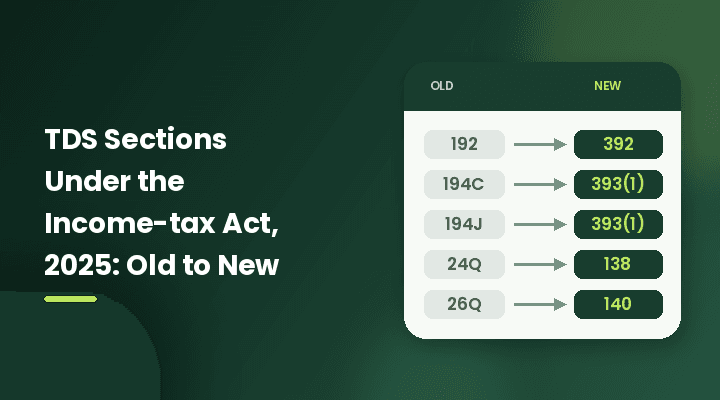
TDS sections under the Income-tax Act, 2025 are the provisions an employer now cites when it deducts tax at source. From 1 April 2026, tax on salary is deducted under section 392 instead of section 192. Almost every other payment to a resident, such as contractor bills, professional fees, rent and commission, sits in one table under section 393(1), and each payment is identified by its serial number in that table. Fees to a chartered accountant, for example, fall under section 393(1), Table Sl. No. 6(iii), where they used to fall under section 194J.
For most payments the rates and thresholds did not move. What changed is the paperwork around them: the section you quote in a vendor contract, the four-digit section code in the quarterly statement, and the form numbers. Form 24Q is now Form 138, Form 26Q is now Form 140, Form 16 is now Form 130 and Form 16A is now Form 131. A wrong tag does not change the tax, but it can leave a default on TRACES to clear with a correction statement.
This guide maps the TDS sections a company with 50 or more employees deals with, plus the forms, due dates and transition points. How salary tax is worked out under each regime is covered in our post on income tax on salary for FY 2026-27.
Nothing here is tax advice. Law as at 16 November 2026: the Income-tax Act, 2025 and the Income-tax Rules, 2026, in force from 1 April 2026, with the Finance Act, 2026 amendments.
| Key TDS figures at a glance | Rule or figure | Where it sits (2025 Act unless stated) | Old reference (1961 Act) |
|---|---|---|---|
| Salary | Average rate on estimated income for the year, deducted when salary is paid | Section 392(1); section code 1002 | Section 192 |
| Contract work, including supply of manpower | 1% (individual or HUF contractor) or 2% (others), above ₹30,000 a bill or ₹1,00,000 a year | Section 393(1), Table Sl. No. 6(i); section 402(47)(f); codes 1023, 1024 | Section 194C |
| Professional fees | 10% above ₹50,000 a year | Section 393(1), Table Sl. No. 6(iii); code 1027 | Section 194J |
| Technical services, call centres | 2% above ₹50,000 a year | Section 393(1), Table Sl. No. 6(iii); code 1026 | Section 194J |
| Director's fees or commission (not salary) | 10%, no threshold | Section 393(1), Table Sl. No. 6(iii); code 1028 | Section 194J |
| Rent paid by a company or firm | 2% (plant, machinery, equipment) or 10% (land, building, furniture), above ₹50,000 a month | Section 393(1), Table Sl. No. 2(ii); codes 1008, 1009 | Section 194-I |
| Payee without a valid PAN | Highest of the normal rate, the rates in force and 20% | Section 397(2)(b)(i) | Section 206AA |
| Deposit of TDS | Within seven days after the month ends; 30 April for March | Rule 218(2) | Rule 30 |
| Quarterly statements | 31 July, 31 October, 31 January and 31 May | Section 397(3)(b), rule 219; Forms 138 and 140 | Section 200(3), rule 31A; Forms 24Q and 26Q |
| Late filing fee | ₹200 a day, capped at the tax deductible | Section 427 | Section 234E |
| Interest on late deduction or deposit | 1% a month until deducted, then 1.5% a month until paid | Section 398(3)(a) | Section 201(1A) |
| Correction statements | Within two years from the end of the tax year in which the statement was due | Section 397(3)(f) | Section 200(3) |
How did TDS sections change under the Income-tax Act, 2025?
The Income-tax Act, 2025 replaced the 1961 Act from 1 April 2026. According to the Income Tax Department's note on its salient features, the 65 sections on TDS and TCS in the old Act were consolidated into 13. The new Act also drops "previous year" and "assessment year" in favour of a single "tax year", so FY 2026-27 is now tax year 2026-27.
Three sections carry most of the load:
| Section | What it covers | Main old sections it absorbed |
|---|---|---|
| 392 | Tax on salary, plus tax on an accumulated PF balance paid to an employee under section 392(7) | 192, 192A |
| 393 | Tax on all other payments, set out in tables: 393(1) for payments to residents, 393(2) for non-residents and 393(3) for payments to any person, with no-deduction cases in sub-sections (4) to (9) | 193, the 194 series, 195, 197A and others |
| 394 | Tax collected at source (TCS) | 206C |
Nearby, section 395 covers lower-deduction and TDS certificates, section 397 covers PAN, deposit and quarterly statements, section 398 covers defaults, and section 402 holds the definitions, including "work", "rent" and "professional services".
How do you read a section 393 reference and its section code?
Under the 1961 Act each payment had its own section. Under the 2025 Act each payment has a row in a table, so "section 393" on its own tells nobody whether you meant 1%, 2% or 10%. The department's own forms cite the row, for example "section 393(1) [Table: Sl. No. 8(iii)]" in the title of Form 138. The code list in Form 140 goes one step further and adds the rate column, such as "393(1) [Table: Sl. No. 6(iii).D(b)]" for professional fees.
The quarterly statements also ask for a four-digit section code against every deductee row, listed in the notes to Form 138 (salary) and Form 140 (other resident payments). For example, 1002 is salary paid by a non-government employer, 1024 is contract work by a contractor that is not an individual or HUF, and 1027 is professional fees. Your payroll and accounts systems need to carry these codes.
A workable citation for a purchase order or vendor master reads: "TDS under section 393(1) [Table: Sl. No. 6(iii)] of the Income-tax Act, 2025, section code 1027."
What are the new TDS sections for payroll and vendor payments?
Rates are for resident payees with a valid PAN, for tax year 2026-27, with a company as the payer. A company is both a "designated person" for contract work and a "specified person" for professional fees, rent and commission under section 402.
| Payment | Old section (1961) | New reference (2025 Act) | Section code | Threshold | Rate |
|---|---|---|---|---|---|
| Salary (non-government employer) | 192 | 392(1) | 1002 | None; tax is deducted once estimated tax for the year is above nil | Average rate on estimated income for the year |
| Accumulated PF balance paid to an employee | 192A | 392(7) | 1004 | ₹50,000 or more | 10% |
| Contract work, including supply of manpower: contractor is an individual or HUF | 194C | 393(1), Table Sl. No. 6(i) | 1023 | ₹30,000 for a single sum or ₹1,00,000 in the year | 1% |
| Contract work, including supply of manpower: any other contractor | 194C | 393(1), Table Sl. No. 6(i) | 1024 | Same as above | 2% |
| Fees for technical services, call centre operators, film royalty | 194J | 393(1), Table Sl. No. 6(iii) | 1026 | ₹50,000 in the year | 2% |
| Fees for professional services (CAs, lawyers, architects, engineers) | 194J | 393(1), Table Sl. No. 6(iii) | 1027 | ₹50,000 in the year | 10% |
| Fees or commission to a director, other than salary | 194J | 393(1), Table Sl. No. 6(iii) | 1028 | Nil | 10% |
| Commission or brokerage (not insurance) | 194H | 393(1), Table Sl. No. 1(ii) | 1006 | ₹20,000 in the year | 2% |
| Rent of plant, machinery or equipment | 194-I | 393(1), Table Sl. No. 2(ii) | 1008 | ₹50,000 for a month or part of a month | 2% |
| Rent of land, building, furniture or fittings (offices, warehouses, leased staff housing) | 194-I | 393(1), Table Sl. No. 2(ii) | 1009 | ₹50,000 for a month or part of a month | 10% |
| Business benefit or perquisite to a non-employee (dealer trips, gifts to consultants) | 194R | 393(1), Table Sl. No. 8(iv) | 1033 | ₹20,000 in the year | 10% |
| Salary, commission, bonus or interest paid by a firm to a partner | 194T | 393(3), Table Sl. No. 7 | 1067 | ₹20,000 in the year | 10% |
Rows, rates and thresholds are from section 393 and the code lists in Forms 138 and 140. Once a threshold is crossed, tax is deducted on the whole amount, at credit or payment, whichever is earlier.
Which TDS cases do payroll teams get wrong?
Whole-time directors. A director on the payroll is an employee, so their salary stays under section 392. Serial number 6(iii) covers fees and commission to a director "other than those on which tax is deductible under section 392". Sitting fees to an independent director go there, with no threshold.
Employee perquisites. Perquisites given to your own employees are salary. They are taxed through section 392, and the employer reports them in Form 123 (formerly Form 12BA). The 8(iv) row is for a benefit or perquisite that arises from the recipient's business or profession, such as a trip for a dealer or a gift to a consultant.
PF withdrawals. Section 392(7) puts the deduction on the trustees of the EPF Scheme or the person authorised under it to pay the balance, at 10% where the payment is ₹50,000 or more and the balance is taxable. In a company with an exempted PF trust, the trust deducts. Section code 1004 is reported in Form 140, not Form 138.
Manpower supply. From 1 April 2026, the Finance Act, 2026 added "supply of manpower to a person to work under his supervision, control or direction" to the definition of "work" in section 402(47)(f). The department's Budget 2026 FAQs say this settles that manpower supply is taxed under serial number 6(i) or 6(ii), not as fees for technical services. The definition turns on control: the agency's workers have to work under your supervision. A payroll processing vendor or a consultant delivering a finished piece of work is not supplying manpower, so check the contract before re-tagging.
No PAN. If the payee has not given a valid PAN, section 397(2)(b)(i) applies the highest of three rates: the rate in the relevant row, the rates in force, or 20% (5% for the purchase-of-goods and e-commerce rows). The statement shows reason code "C" against that deductee. Section 397(2) has no separate higher rate for non-filers, so a chart that still lists section 206AB is out of date.
Which forms replaced Form 24Q, 26Q, 16 and 16A?
The Income-tax Rules, 2026 renumbered the TDS forms. The ones payroll and accounts teams use are:
| Purpose | Old form (1962 Rules) | New form (2026 Rules) | Section and rule |
|---|---|---|---|
| Quarterly TDS statement: salary | 24Q | 138 | Section 397(3)(b), rule 219 |
| Quarterly TDS statement: other payments to residents | 26Q | 140 | Section 397(3)(b), rule 219 |
| Quarterly TDS statement: payments to non-residents | 27Q | 144 | Section 397(3)(b), rule 219 |
| Quarterly TCS statement | 27EQ | 143 | Section 397(3)(b), rule 219 |
| Annual salary TDS certificate | 16 | 130 | Section 395(4)(b), rule 215 |
| Quarterly non-salary TDS certificate | 16A | 131 | Section 395(4)(a), rule 215 |
| Employee's claims for deductions and exemptions | 12BB | 124 | Section 392(5)(b), rule 205 |
| Income from a previous employer and other income | 12B and 12BAA | 122 | Section 392(4)(a), rule 204 |
| Statement of perquisites | 12BA | 123 | Section 392(5)(a), rule 204(2) |
| Application for a lower or nil deduction certificate | 13 | 128 | Section 395(1), rule 213 |
| Declaration for no deduction (old 15G and 15H merged) | 15G, 15H | 121 | Section 393(6), rule 211 |
Every mapping above comes from the Income Tax Department's notes and FAQs on each form. For the employee side of the change, see Form 12BB is now Form 124 and our Form 16 guide for employers, which covers Form 130.
What are the TDS deposit and return due dates under the new Act?
The dates a payroll calendar runs on did not move. The section and rule numbers behind them did.
| Obligation | Due date | Reference |
|---|---|---|
| Deposit TDS (non-government deductor) | Within seven days from the end of the month of deduction; by 30 April for March | Rule 218(2) |
| Form 138 and Form 140, Q1 (April to June) | 31 July | Section 397(3)(b), rule 219 |
| Form 138 and Form 140, Q2 (July to September) | 31 October | Same |
| Form 138 and Form 140, Q3 (October to December) | 31 January | Same |
| Form 138 and Form 140, Q4 (January to March) | 31 May after the tax year | Same |
| Form 131 to vendors and other deductees | 15 August, 15 November, 15 February and 15 June | Section 395(4)(a), rule 215 |
| Form 130 to employees | 15 June after the tax year | Section 395(4)(b), rule 215 |
| Correction statement | Within two years from the end of the tax year in which the statement was due | Section 397(3)(f) |
The department's note on Forms 130 to 133 says a certificate is valid only if it is downloaded from TRACES.
Correction window. The department's FAQ example: a Form 138 for Q3 of tax year 2026-27 can be corrected up to 31 March 2029. Section 397(3)(f) also covers statements due under section 200 of the 1961 Act, so a Q3 2025-26 Form 24Q, due on 31 January 2026, can be corrected only until 31 March 2028. Check which old PAN mismatches or short-deduction defaults on TRACES are close to the cut-off.
Late fee and interest. Section 427 charges ₹200 for every day a statement is late, capped at the tax deductible, and the fee has to be paid before the statement is filed. Section 398(3)(a) charges interest at 1% a month or part of a month until tax is deducted, and 1.5% a month from deduction to payment, also payable before filing. The department's FAQs list penalty proceedings under sections 461 and 465(2)(g) as a further risk.
Expense disallowance. If TDS on a payment is not deducted or not paid, the expense can be disallowed in computing business income under section 35(b) and allowed in the year the tax is deducted and paid.
Prosecution. According to the department's Budget 2026 FAQs, the Finance Act, 2026 cut the maximum punishment for not paying TDS to the government to two years, with a fine as the minimum, from 1 April 2026.
How does the 1961 to 2025 Act transition work for payroll?
The department's salient features note says the 1961 Act continues to apply to tax year 2025-26 and earlier, and the 2025 Act applies from tax year 2026-27. For payroll, that splits the work like this:
- Salary paid up to 31 March 2026: section 192, with Q4 of FY 2025-26 reported in Form 24Q (due 31 May 2026) and Form 16 for FY 2025-26 (due 15 June 2026).
- Salary paid from 1 April 2026: section 392, Form 138 from Q1 of tax year 2026-27, and Form 130 for tax year 2026-27, due by 15 June 2027.
- Certificates and declarations: a certificate covers the period stated on it. From 2026-27, the payee applies in Form 128 for a certificate under section 395(1), and no-deduction declarations come in Form 121 under section 393(6). You upload the Form 121 details you receive by the 7th of the month after each quarter.
- Internal documents: vendor master tags, purchase order clauses ("TDS under section 194J"), offer letters, payslip footers and the investment declaration window (Form 124 instead of Form 12BB) all need the new references.
Worked example 1: a chartered accountant on a monthly retainer
A Pune manufacturer with 450 employees retains a chartered accountant, who practises in her own name, at ₹40,000 a month from April 2026 to review payroll and statutory filings. She gives her PAN. Accountancy is a professional service under section 402(28), so the payment falls under section 393(1), Table Sl. No. 6(iii), at 10%.
- April: fees so far are ₹40,000, below the ₹50,000 threshold for the year. No TDS.
- May: fees for the year reach ₹80,000 and cross the threshold. Tax is due on the entire amount, so the May deduction is 10% of ₹80,000, which is ₹8,000, under section code 1027.
- June to March: ₹4,000 a month.
- Year total: fees of ₹4,80,000 and TDS of ₹48,000, reported in Form 140 each quarter and certified to her in Form 131.
The common slip is to deduct only ₹4,000 in May and find the gap at the quarter-end reconciliation, by which time interest is running under section 398(3).
Worked example 2: a manpower agency invoice
The same company takes 60 contract workers from a staffing agency that is a private limited company. The workers are on the factory floor under the company's supervisors. The agency bills ₹6,00,000 a month for the service, before GST.
- The workers work under the company's supervision and control, so the payment is "work" under section 402(47)(f) and falls under section 393(1), Table Sl. No. 6(i).
- The agency is not an individual or HUF, so the rate is 2% and the section code is 1024.
- TDS is ₹12,000 a month and ₹1,44,000 for the year.
If the accounts team carries the agency at the 10% professional rate from an old vendor setup, it deducts ₹60,000 a month instead of ₹12,000. That is ₹48,000 of the agency's cash withheld every month. If the old setup used the 2% technical services rate, the amount matches but the row and code are wrong.
Worked example 3: one month's non-salary TDS register
The company's non-salary TDS register for May 2026:
| Payment | New reference | Section code | Amount (₹) | TDS (₹) |
|---|---|---|---|---|
| Chartered accountant's retainer (a steady month) | 393(1), Table Sl. No. 6(iii) | 1027 | 40,000 | 4,000 |
| Manpower agency (example 2) | 393(1), Table Sl. No. 6(i) | 1024 | 6,00,000 | 12,000 |
| Office rent to an individual landlord | 393(1), Table Sl. No. 2(ii) | 1009 | 1,20,000 | 12,000 |
| Sitting fees to an independent director (2 meetings at ₹25,000) | 393(1), Table Sl. No. 6(iii) | 1028 | 50,000 | 5,000 |
| Total | 33,000 |
The ₹33,000 is deposited by 7 June 2026 and reported in Form 140 for Q1, due 31 July 2026; salary TDS goes in Form 138. The director row has no threshold, so even one ₹25,000 meeting fee carries ₹2,500 of TDS.
How do you move your TDS process to the 2025 Act?
- List every payment type you deduct on. Group twelve months of Form 24Q and 26Q deductee rows by old section.
- Map each payment type to its new row and section code. Use the table above and record the full reference, such as "393(1) [Table: Sl. No. 6(i)]", not just "393".
- Re-tag the vendor master. Each vendor needs a section code, PAN status and payee type (individual or HUF, or other). Check each staffing contract for supervision and control before moving it to serial number 6(i).
- Update payroll for section 392. Collect Form 124 and Form 122 under the new names, and remove section 192 from payslips and offer letters.
- Ask for fresh certificates and declarations. Lower or nil deduction needs a current section 395(1) certificate or a Form 121 declaration.
- Deposit by the 7th. March deductions are due by 30 April.
- File quarterly statements on time. Form 138 for salary and Form 140 for other resident payments, by 31 July, 31 October, 31 January and 31 May. Download Form 131 for vendors each quarter.
- Reconcile before every filing. Match challans to deductee rows, check that each payee's credit appears in Form 168, the annual information statement, and clear PAN or code mismatches while they are still inside the two-year correction window.
- Close the year. Issue Form 130 to every employee by 15 June 2027 for tax year 2026-27.
For the full monthly list of PF, ESI, TDS and other dates, see the statutory compliance calendar for 2026-27 and the payroll compliance checklist.
What are the common TDS mistakes in the first year?
- Citing "section 393" with no serial number. The payee, the auditor and the department cannot tell which row, and so which rate, you applied.
- Using an old chart. Charts that list section 206AB, or the ₹30,000 threshold for professional fees, are out of date. The threshold in serial number 6(iii) is ₹50,000 a year.
- Treating every staffing invoice the same way. Only manpower working under your control is "work" at 1% or 2%.
- Putting a whole-time director's salary in the director fees row. Salary of an employee-director goes under section 392 and in Form 138.
- Reporting PF withdrawals in the salary statement. Section code 1004 belongs in Form 140.
TDS sections FAQs
What is the TDS section for salary under the new Income-tax Act?
Section 392 of the Income-tax Act, 2025 replaced section 192 for salary paid from 1 April 2026. Tax on an accumulated PF balance paid to an employee, which was section 192A, is now section 392(7).
What is the new section for 194J?
Fees for professional or technical services are now section 393(1), Table Sl. No. 6(iii). The threshold is ₹50,000 a year. The rate is 2% for technical services, call centre operators and film royalty, and 10% for professional fees. Director fees other than salary carry 10% with no threshold. Codes are 1026, 1027 and 1028.
What is the new section for 194C, and what is the limit?
Contract work is now section 393(1), Table Sl. No. 6(i). TDS applies when a single sum is more than ₹30,000 or the year's total is more than ₹1,00,000. The rate is 1% where the contractor is an individual or HUF (code 1023) and 2% for others (code 1024). From 1 April 2026 it also covers manpower supplied to work under the payer's control.
What is the TDS section for rent under the Income-tax Act, 2025?
Rent paid by a company, firm or other specified person is section 393(1), Table Sl. No. 2(ii): 2% for plant, machinery or equipment and 10% for land, building, furniture or fittings, where rent is more than ₹50,000 for a month or part of a month. Rent paid by other individuals and HUFs falls under serial number 2(i) at 2%.
Which forms replaced Form 24Q and Form 16?
Form 138 replaced Form 24Q for quarterly salary TDS statements, and Form 130 replaced Form 16 as the annual salary certificate, from tax year 2026-27. Form 140 replaced Form 26Q and Form 131 replaced Form 16A.
Was Q4 of FY 2025-26 filed in Form 24Q or Form 138?
In Form 24Q, by 31 May 2026, because January to March 2026 was a 1961 Act period. Form 138 starts with Q1 of tax year 2026-27.
Did TDS rates change under the Income-tax Act, 2025?
No. For the payments in this guide, section 393 carries the rates and thresholds that applied for 2025-26, and the department's salient features note says the new Act made no major policy changes. The Finance Act, 2026 made targeted changes, such as treating manpower supply as work, exempting interest awarded by a Motor Accidents Claims Tribunal to an individual from TDS, and changing several TCS rates.
Is there an official chart comparing 1961 and 2025 Act sections?
Yes. The department's salient features note says a table mapping provisions of the 1961 Act to the 2025 Act is available on incometaxindia.gov.in.
How does Engage help with salary TDS?
Most first-year errors under a new law are tagging errors. On the salary side, Engage Payroll, built for companies with 50 or more employees, computes TDS on salary inside every payroll run along with PF, ESI, professional tax and LWF. It projects annual tax under both regimes and adjusts it each cycle as declarations, proofs and variable pay come in.
Employees record their regime choice and file Form 124 declarations in self-service, and upload proofs against them. Role-based access controls who can see salary data, and every change to a payroll record is written to an audit trail with the user and timestamp. If you want to check a single employee's monthly deduction first, the TDS calculator is free to use. For the step-by-step monthly process, see how to calculate payroll in India.
Non-salary TDS usually runs in your accounting system, so share the section code table with that team. For definitions, see the glossary entries on TDS, TDS returns, Form 16A and Form 15G.
To see what it would cost for your team size, check Engage pricing.
Sources
- Income-tax Act, 2025, section 393. Income Tax Department. Payment tables and no-deduction cases.
- Income-tax Act, 2025, section 392. Salary and accumulated PF balance, including section 392(7).
- Income-tax Act, 2025, section 397. PAN, deposit, statements and corrections.
- Income-tax Act, 2025, section 398. Assessee in default and interest.
- Income-tax Act, 2025, section 402. Definitions, including "work" in clause (47)(f).
- Income-tax Act, 2025, section 427. Fee for late statements.
- Income-tax Rules, 2026, rule 218. Time for depositing tax deducted.
- Form No. 138 and Form No. 140. Income-tax Rules, 2026, with the section code lists.
- Form No. 138 FAQs and Form No. 140 FAQs. Due dates, corrections, fees and penalties.
- Income Tax Department note on TDS certificates, Forms 130 to 133. Issue dates and TRACES generation.
- Income Tax Department notes on Form 121, Form 122, Form 123, Form 124, Form 128, Form 143 and Form 144. Old and new form numbers.
- Salient features of the new Income-tax Act. Income Tax Department. Effective date, tax year and consolidation.
- FAQs on Budget 2026. Income Tax Department. Manpower supply, MACT interest, prosecution and section 35(b).