
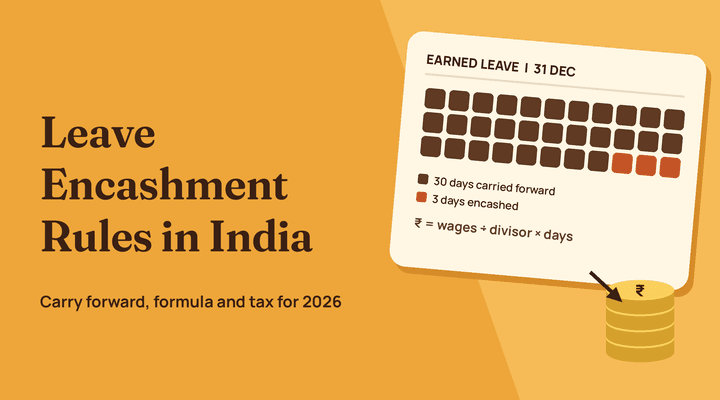
Leave encashment is the payment an employer makes for earned leave that an employee has built up and not taken. Under the OSH Code, in force since 21 November 2025, a worker can carry forward up to 30 days of earned leave into the next calendar year, can encash leave above that limit, and must be paid for the full balance within two working days of resigning, being dismissed or being discharged. On tax, leave encashed during service is taxable as salary, and leave encashed at retirement or resignation by a private sector employee is deductible up to the least of four limits, one of which is a lifetime cap of ₹25 lakh under section 19 of the Income-tax Act, 2025.
If your leave policy was written for the Factories Act or a state Shops Act, check its carry forward cap and payment date against the Code first. You can check a single figure in the free leave encashment calculator, or go straight to the calculation formula, the tax exemption limits or the worked examples.
Nothing here is legal or tax advice. The four Labour Codes came into force on 21 November 2025 and the Income-tax Act, 2025 on 1 April 2026. State Shops and Establishments Acts continue to apply alongside the Codes. Law as at 26 November 2026.
| Leave encashment at a glance | Rule or figure | Where it sits | Section of this guide |
|---|---|---|---|
| Who the Code's leave rules cover | Workers in an establishment with 10 or more workers. Managerial and administrative staff, and supervisors drawing more than ₹18,000 a month, are outside | OSH Code, section 2(1)(v) and 2(1)(zzl) | 2 |
| Eligibility for annual leave | 180 days or more of work in the calendar year | OSH Code, section 32(1)(i) | 3 |
| Rate of earning | 1 day for every 20 days worked (1 for 15 for adolescents and below-ground mine workers) | Section 32(1)(ii) | 3 |
| Carry forward limit | 30 days into the next calendar year | Section 32(1)(vii)(a) | 4 |
| Leave applied for and refused | Carried forward without any limit | Section 32(1)(vii)(b) | 4 |
| Encashment during service | On the worker's demand at the end of the calendar year; leave above 30 days can be encashed | Section 32(1)(viii) and (ix) | 5 |
| Salary base | Basic pay, DA and retaining allowance, plus any excess of excluded items over 50% of total remuneration | Section 2(1)(zzj) | 6 |
| Payment on exit | Before the end of the second working day after discharge, dismissal or quitting; within two months of superannuation or death | Section 32(1)(vi) | 7 |
| Penalty for breach | ₹2 lakh to ₹3 lakh under the general penalty, plus up to ₹2,000 a day if it continues after conviction; section 97 provides ₹50,000 to ₹1 lakh for contravening any provision | Sections 94 and 97 | 7 |
| Tax on encashment during service | Fully taxable as salary | Income-tax Act, 2025, section 16(h) | 8 |
| Tax at retirement or resignation, other employees | Least of four limits, including ₹25 lakh over the employee's lifetime | Section 19(1), Table, serial 14, and 19(2)(b) and (f); Notification 31/2023 | 9 |
What is leave encashment?
Leave encashment means converting unused paid leave into money. The law treats its two forms differently:
- During service. The employee keeps working and is paid for part of the balance, usually at the end of the leave year when the balance would otherwise cross the carry forward limit.
- On exit. The whole encashable balance is paid in the full and final settlement when the employee resigns, retires, is dismissed or dies.
Only earned leave is encashable as a matter of law. Earned leave is also called privilege leave (PL), annual leave or EL, and the OSH Code calls it "annual leave with wages". Casual and sick leave normally lapse at year end unless the policy allows encashment. The unused balance is the accrued leave, and the part moved into the next year is the carry forward. Casual leave, sick leave and holidays are covered in the leave policy requirements guide.
Which law sets the leave encashment rules for your employees?
For workers in an establishment with 10 or more workers, section 32 of the Occupational Safety, Health and Working Conditions Code, 2020 (OSH Code) sets the floor. For everyone else, the state Shops and Establishments Act and your leave policy decide. Where an employee falls under both the Code and a state Act, the more favourable rule applies on each point.
| Who | What governs earned leave and encashment | Source |
|---|---|---|
| Workers in factories, offices, shops and other establishments with 10 or more workers | OSH Code, section 32 | Section 2(1)(v)(i) on establishment; section 2(1)(zzl) on worker |
| Staff employed mainly in a managerial or administrative capacity | Leave policy and contract, plus any state Shops Act that covers them | Excluded by section 2(1)(zzl)(iii) |
| Supervisors drawing wages above ₹18,000 a month | Leave policy and contract, plus any state Shops Act that covers them | Excluded by section 2(1)(zzl)(iv) |
| Workers in shops and commercial establishments | OSH Code and the state Act together; the more favourable benefit continues | OSH Code, section 120; MoLE FAQs 215 and 229 |
The worker definition covers anyone doing "manual, unskilled, skilled, technical, operational, clerical or supervisory work", including sales promotion employees. A software engineer earning ₹1 lakh a month is still a worker, because the ₹18,000 test applies only to supervisors. Ministry of Labour and Employment (MoLE) FAQ 211 confirms this for the leave provisions.
Section 143(1)(a) of the OSH Code repealed the Factories Act, 1948, but state Shops and Establishments Acts are not in the repeal list. Section 120 keeps any more favourable benefit, as MoLE FAQ 215 confirms for leave. In Maharashtra, section 18(5) of the Shops and Establishments Act, 2017 allows earned leave to accumulate up to 45 days, and section 18(10) pays leave at the daily average of wages for days worked in the preceding three months, leaving out overtime. A Pune office covered by both laws compares them point by point and gives the better figure.
How much earned leave does a worker get under the new labour code?
A worker who has worked 180 days or more in a calendar year earns one day of leave for every 20 days of work in that year, under section 32(1) of the OSH Code. Adolescent workers and workers below ground in a mine earn one day for every 15 days.
- Days that count but do not earn: lay-off, maternity leave and annual leave taken count towards the 180 days, but no leave is earned for them (clause (iii)).
- Holidays inside a leave period: holidays falling between, before or after the leave are excluded from the leave counted (clause (iv)). The sandwich leave guide explains the effect on your policy.
- Mid-year joiners: a worker who joins after 1 January earns at the same rate if they work one-fourth of the days in the rest of the calendar year (clause (v)).
The Code has no rule for a fraction such as 13.2 days, so write a rounding rule into the policy.
What is the leave carry forward limit under the new labour code?
A worker can carry forward up to 30 days of unused earned leave into the next calendar year. Section 32(1)(vii) has two parts:
- Clause (a): the total leave carried forward to the next year shall not exceed 30 days.
- Clause (b): leave the worker applied for and was refused is carried forward without any limit.
MoLE FAQ 212 says the same. Keep refused leave in a separate counter, because a system that pools it with ordinary leave will cut it at the 30-day cap.
Section 32 counts leave "in a calendar year". If your company runs an April to March leave year, run the 30-day check for workers at 31 December as well, or move workers to a calendar leave year. A higher carry forward limit in your policy, such as 45 or 60 days, is allowed under section 120(2).
Can employees encash earned leave every year?
Yes, for workers covered by the OSH Code. Two clauses of section 32(1) give a right to encash during service:
- Clause (viii): the worker is entitled, on demand, to encashment of leave at the end of the calendar year.
- Clause (ix): where the total leave exceeds the 30-day carry forward limit, the worker is entitled to encash the excess.
On the bare text, clause (viii) allows a demand at the end of each year and clause (ix) covers the days above 30. MoLE FAQ 216 reads it more narrowly: leave above 30 days "if applied but not granted by the employer" can be encashed at the end of the calendar year, and the full balance at separation.
Until this is clarified, the lower-risk course is to pay out ordinary leave above 30 days at the end of each calendar year and to consider any written demand under clause (viii). Confirm the position with your labour law adviser. For staff outside the Code, annual encashment is a matter of policy.
How is leave encashment calculated?
Leave encashment is the per-day wage multiplied by the number of encashable days:
Leave encashment = (monthly wages ÷ divisor) × encashable leave days
1. The salary base. Workers under the OSH Code get leave "with wages", and section 2(1)(zzj) defines wages to include basic pay, dearness allowance and retaining allowance. It excludes:
- bonus under any law that is not part of the remuneration under the terms of employment;
- the value of house accommodation, light, water, medical attendance, other amenity or any service excluded by government order;
- employer contributions to any pension or provident fund, and interest on them;
- conveyance allowance or the value of any travelling concession;
- sums paid to meet special expenses of the job;
- house rent allowance;
- remuneration under an award or settlement, or an order of a court or tribunal;
- overtime allowance;
- commission;
- gratuity payable on termination;
- retrenchment compensation, other retirement benefits, or an ex gratia payment on termination.
The first proviso applies the 50% rule: if items (a) to (i) together exceed half of all remuneration, the excess is added back to wages. Take total remuneration of ₹25,600 a month, with basic and DA of ₹10,000 and allowances of ₹15,600. Half of ₹25,600 is ₹12,800, so ₹2,800 is added back and the wage base becomes ₹12,800.
A second proviso brings conveyance, HRA, award remuneration and overtime back into wages "for the purpose of payment of wages". Whether that reaches leave wages is not settled; the common view uses basic, DA and retaining allowance with the 50% add-back. Confirm with your adviser. See the glossary entries for basic salary and dearness allowance, and the CTC breakup guide for the 50% rule.
2. The divisor. The OSH Code and the OSH (Central) Rules, 2026 do not prescribe a per-day rate for leave wages. Rule 69(3) of the Central Rules fixes the daily wage at 1/26 of monthly wages, but only for overtime. Your policy can use 26, 30 or the actual days in the month, and 26 gives the higher payout. Some state Acts, such as Maharashtra's, fix their own method.
3. The encashable days. On exit, this is the full earned leave balance, including refused leave carried forward. During service, it is the days above the carry forward limit, or the days the worker asks to encash at year end.
When must leave encashment be paid on resignation, termination or retirement?
For workers covered by the OSH Code, leave encashment on resignation, dismissal or discharge must be paid before the end of the second working day after the exit date, and on superannuation or death within two months. Section 32(1)(vi) pays the worker, or the heir or nominee, even if the worker has not completed the work period needed to take the leave.
| Exit event | Deadline | Source |
|---|---|---|
| Resignation, dismissal or discharge | Before the expiry of the second working day from the date of quitting, dismissal or discharge | OSH Code, section 32(1)(vi)(a) |
| Superannuation, or death in service (paid to the heir or nominee) | Before the expiry of two months from the date of superannuation or death | Section 32(1)(vi)(b) |
For employees outside the Code, the policy fixes the timing. Section 17(2) of the Code on Wages, 2019 requires wages within two working days of removal, dismissal, retrenchment or resignation. The MoLE FAQs treat leave encashment as outside wages, so that section may not strictly cover it, but paying it with the final wages keeps the settlement on one date. The full and final settlement guide covers the two-day rule.
Penalty. The OSH Code does not name a penalty for section 32 by itself, and two sections can be read to apply. Section 94, the general penalty, makes the employer or principal employer liable to a penalty of not less than ₹2 lakh and up to ₹3 lakh, and if the contravention continues after conviction, a further penalty of up to ₹2,000 for each day it continues. Section 97(1) covers a contravention of any provision of the Code or rules with a penalty of ₹50,000 to ₹1 lakh, and on a second conviction under the same provision, imprisonment of up to three months, a fine of up to ₹2 lakh, or both (section 97(2)). Separately, section 96(1) imposes ₹50,000 to ₹1 lakh for failing to maintain a register or file returns, or to produce a register or record, and ₹50,000 to ₹2 lakh on a second conviction (section 96(2)). Rule 76 of the OSH (Central) Rules, 2026 requires a leave with wages register in Form XX, kept for five years after the last entry.
Is leave encashment taxable?
Yes, with one relief. Section 16(h) of the Income-tax Act, 2025 includes in salary "any payment received by an employee in respect of any period of leave not availed of by him". The relief is for encashment at the time of retirement, "whether on superannuation or otherwise", under section 19(1):
| When it is paid | Government employee | Any other employee |
|---|---|---|
| During service | Fully taxable | Fully taxable |
| At retirement or resignation | Entire amount deductible (Table, serial 13) | Deductible up to the least of four limits (Table, serial 14) |
Section 19(1) replaced section 10(10AA) of the Income-tax Act, 1961 from 1 April 2026 with the same limits. The Income Tax Department's exempt income page applies the relief to retirement and resignation. It is available in both tax regimes, because section 202(2)(a)(iv) denies only serial 1 of the section 19(1) Table (professional tax) in the new regime.
The employer deducts TDS on the taxable part under section 392(1). See the TDS on salary guide, the TDS calculator and the old and new TDS sections map.
How is the leave encashment tax exemption calculated?
For an employee who is not a Central or State Government employee, the deduction is the least of four amounts under serial 14 of the section 19(1) Table:
- Cash equivalent of leave at credit at retirement, with entitlement counted at no more than 30 days for every year of actual service.
- Ten months' average salary: 10 × the average monthly salary for the ten months immediately before retirement.
- The notified limit: ₹25,00,000, specified by CBDT Notification No. 31/2023 (S.O. 2276(E), 24 May 2023) from 1 April 2023 and continued under the 2025 Act by section 536(2)(j).
- The actual amount received.
"Salary" for limits (a) and (b) is basic pay plus DA if the terms of employment so provide, excluding all other allowances and perquisites (section 19(2)(b)). This is narrower than the OSH Code wage base.
The ₹25 lakh is a lifetime limit. Section 19(2)(f) caps the deduction at the notified limit minus any leave encashment exemption or deduction allowed in earlier tax years, from any employer. For a lateral hire, get a declaration of earlier claims, backed by the old Form 16 or Form 130, before you apply the full limit.
For limit (a), count leave at no more than 30 days for each completed year, then deduct leave taken or encashed during service. Where the policy gives 30 days a year or less, this is usually the actual balance.
Is PF deducted on leave encashment?
No, on the common view. In the Code on Wages part of the MoLE FAQs, FAQ 7 says leave encashment, "if one-time payment and not a regular payment", is not included in wages, and FAQ 8 says it "shall not be added to calculate statutory benefits". FAQ 23 calls encashment under section 32 an annual payment that is not part of wages. On that basis PF is not deducted on leave encashment during service or at exit.
Leave encashment paid every month as a regular part of pay is not a one-time payment and could be argued to be wages, so confirm the PF and ESI treatment with your adviser if you run monthly encashment. The PF calculation guide covers the ₹25,000 wage ceiling.
Worked examples: carry forward, year-end encashment and exit tax
Names and figures are illustrative.
Example 1: year-end encashment for a factory worker. Sunita is a machine operator with basic ₹16,500 and DA ₹3,500, a total of ₹20,000. She also gets HRA of ₹4,000 and conveyance of ₹1,600, so total remuneration is ₹25,600. The excluded items come to ₹5,600, below half of ₹25,600, so nothing is added back and her wage base is ₹20,000.
| Step | Days |
|---|---|
| Balance carried forward on 1 January 2026 | 30 |
| Days worked in 2026 | 270 (above 180, so eligible) |
| Leave earned in 2026 at 1 for every 20 days | 13 (13.5, rounded down under the company's written rule) |
| Leave taken in 2026 | 10 |
| Balance on 31 December 2026 | 33 |
| Carried forward to 2027 | 30 |
| Excess to encash under section 32(1)(ix) | 3 |
- With a 26-day divisor: ₹20,000 ÷ 26 × 3 = ₹2,308 (rounded).
- With a 30-day divisor: ₹20,000 ÷ 30 × 3 = ₹2,000.
The payment is fully taxable as salary in the month it is paid, and on the common view no PF is deducted.
Example 2: resignation where the tax limit bites. Rahul is a regional sales manager in Gurugram in a managerial role, so the OSH Code's leave clauses do not apply and, for this example, his company's policy governs: 24 days of earned leave a year, carry forward up to 60 days, encashment on last drawn basic ÷ 30. He has 8 completed years of service. His basic was ₹75,000 a month until March 2026 and ₹80,000 from April, with no DA. He resigns with effect from Monday 30 November 2026 with 52 days at credit, and he had claimed a ₹1,20,000 leave encashment deduction when he left his previous employer.
- Payout under the policy: ₹80,000 ÷ 30 × 52 = ₹1,38,667 (rounded).
- Average monthly salary for February to November 2026: (2 × ₹75,000 + 8 × ₹80,000) ÷ 10 = ₹79,000.
| Limit under serial 14 | Working | Amount |
|---|---|---|
| (a) Cash equivalent of leave at credit | 24 days a year is below the 30-day cap, so the 52 days stand: 52 × ₹79,000 ÷ 30 | ₹1,36,933 |
| (b) Ten months' average salary | 10 × ₹79,000 | ₹7,90,000 |
| (c) Notified limit less earlier deduction | ₹25,00,000 minus ₹1,20,000 | ₹23,80,000 |
| (d) Actual amount received | Policy payout | ₹1,38,667 |
| Deduction | Least of (a) to (d) | ₹1,36,933 |
| Taxable as salary | ₹1,38,667 minus ₹1,36,933 | ₹1,734 |
The deduction is lower than the payout because limit (a) uses the ten-month average and the policy uses last drawn basic. The company pays the encashment with his final salary by Wednesday 2 December 2026, the second working day, and adds ₹1,734 to his November taxable salary for TDS. Gratuity is worked out separately, as the gratuity calculation guide shows.
Leave encashment policy checklist for HR
- Map each employee group to its law: section 32 for workers, the policy for managers and supervisors above ₹18,000, and the state Shops Act for each location.
- Set eligibility at 180 days for workers and accrual at 1 day per 20 days worked, with a written rounding rule.
- Set carry forward at 30 days or more for workers on a calendar year, with refused leave in its own uncapped counter.
- Write down the salary base and the divisor, and apply the 50% add-back test.
- Pay the year-end excess above the carry forward limit, and decide how to handle a demand under clause (viii).
- Build exit timing into the F&F: two working days for resignation, dismissal or discharge; two months for superannuation or death.
- Apply the four tax limits at exit after collecting details of earlier leave encashment claims, and keep the Form XX leave register.
For related policies, see comp off rules, maternity leave rules and the LOP calculation guide.
Leave encashment FAQs
Is leave encashment taxable?
Yes. Leave encashed during service is fully taxable as salary under section 16(h) of the Income-tax Act, 2025. At retirement or resignation it is deductible in full for government employees, and up to the least of four limits, with a ₹25 lakh lifetime cap, for everyone else. The deduction is available in the new regime too.
Can unused earned leave lapse at the end of the year?
No, for workers covered by the OSH Code. Up to 30 days carries forward, refused leave carries forward without limit, and the excess above 30 days can be encashed. A lapse clause can apply to staff outside the Code if the policy and state law allow it.
Is leave encashment calculated on basic or gross salary?
Neither, for workers under the OSH Code. It is calculated on wages under section 2(1)(zzj), which is basic pay, DA and retaining allowance plus the 50% add-back. For other staff, the policy decides.
Do employees get leave encashment if they are dismissed for misconduct?
Yes, for workers covered by the OSH Code. Section 32(1)(vi) gives the leave payment to a worker who is "discharged or dismissed" with no exception for misconduct. Recover lawful dues through the F&F, but do not withhold the leave payment as a penalty.
What happens to leave encashment if an employee absconds?
It becomes due once employment actually ends. For a worker, the two-working-day clock under section 32(1)(vi) runs from the date of the termination order. Issue the order under your absconding procedure, then pay the leave and other dues to the bank account on record. The absconding employee guide sets out the steps.
Can an employee refuse to take leave and insist on encashment?
No. An employee can insist only on the encashment that the law or the policy gives. For workers, leave above 30 days at year end is encashed, and a year-end demand under section 32(1)(viii) is read in different ways (see section 5). Below that, you can require the leave to be taken or carried forward as the policy says.
Is leave encashment paid on the death of an employee?
Yes. For workers, section 32(1)(vi) requires payment to the heir or nominee within two months of death. The Income Tax Department's exempt income page states that leave encashment on death is fully exempt. Confirm the tax position in the family's hands with your tax adviser.
How does Engage handle leave carry forward and encashment?
In Engage leave management, you set up leave policies by location or function, each with its own leave types, accrual rates, prorations, carry-over provisions and eligibility rules, and a holiday calendar for each location. Employees check balances and apply for leave on the mobile app. Approved leave and loss-of-pay days flow into Engage payroll, and at exit, gratuity, leave encashment and notice recovery are computed together in the full and final settlement. Engage is built for organisations with 50 or more employees, and 500+ companies run payroll on it. If you want your carry forward and encashment rules set up before the 31 December year-end run, see the plans on the Engage pricing page and book a trial.
Related reading: the leave encashment glossary entry, the leave management software guide and the free HR tools.
Sources
- Occupational Safety, Health and Working Conditions Code, 2020. Gazette of India, 29 September 2020, as hosted by DGFASLI, Ministry of Labour and Employment. Section 2(1)(v) on establishments; section 2(1)(zzj) on wages; section 2(1)(zzl) on workers; section 32 on annual leave with wages; sections 94, 96 and 97 on penalties; section 120 on more favourable benefits; section 143 on repeals.
- Notification S.O. 5321(E), 21 November 2025. Ministry of Labour and Employment. Brings the OSH Code into force from 21 November 2025.
- Occupational Safety, Health and Working Conditions (Central) Rules, 2026. G.S.R. 345(E), 8 May 2026. Rule 69(3) on the overtime daily wage; rule 76 and Form XX on the register of leave with wages.
- Code on Wages, 2019. Ministry of Labour and Employment. Section 2(y) on wages; section 17(2) on payment of wages on exit.
- Ministry of Labour and Employment, Compilation of FAQs on Four Labour Codes and Central Rules (as on 25 October 2026). Questions 7, 8 and 23 on leave encashment and wages; 211, 212, 213, 215 and 216 on leave and encashment; 229 on state law.
- Income-tax Act, 2025, as amended by the Finance Act, 2026. Income Tax Department. Section 16(h) on leave salary; section 19(1), Table, serials 1, 13 and 14, and section 19(2)(b) and (f) on the leave encashment deduction; section 202(2)(a)(iv) on the new regime; section 392(1) on TDS from salaries; section 536(2)(j) on continuing notifications.
- Threshold limits under the Income-tax Act. Income Tax Department. ₹25,00,000 limit for leave encashment at retirement for non-government employees.
- Increased limit for tax exemption on leave encashment for non-government salaried employees notified. Press Information Bureau, Ministry of Finance, 25 May 2023. Notification No. 31/2023 dated 24 May 2023, ₹25 lakh from 1 April 2023, aggregate across employers and years.
- Exempt income. Income Tax Department. Leave encashment on death, retirement and resignation.
- Maharashtra Shops and Establishments (Regulation of Employment and Conditions of Service) Act, 2017. English text, Labour Department, Government of Maharashtra. Section 18 on leave, accumulation and leave wages.