
The argument for using the HR module in the ERP you already own is a good one and it is usually made in a single sentence. The licence is paid for, the employee master already exists because finance needed cost centres, and one vendor is simpler than two.
That argument is strongest at the moment it is made and weakest eighteen months later. What changes in between is not the software. It is that somebody asks the system a question it was not built to answer. Whether a wage component counts under section 2(y) of the Code on Wages. Whether the quarterly salary statement went out on the right form this year. Why an employee on a factory floor cannot see their leave balance on a phone.
This article is about that gap. It is not an argument that ERP HR modules are bad, because plenty of companies run payroll in one perfectly well and would be worse off moving. It is an argument that the two categories were designed around different centres of gravity, that the difference is predictable rather than accidental, and that there is a specific test you can run on your own installation this week that settles it more honestly than any feature comparison.
The intended reader is whoever has to make or defend this decision: an HR head being told the ERP already does this, a CFO being asked to approve a second system, or an IT lead who will own whatever gets chosen.
Positions are current at September 2026 and reflect the four Labour Codes as brought into force on 21 November 2025, the Employees' Provident Funds Scheme, 2026 and its companion schemes effective 29 June 2026, and the Income-tax Act, 2025 with the Income-tax Rules, 2026 governing salary paid from 1 April 2026. Nothing here describes any particular vendor's product. Test the claims in section 3 against your own installation, not against a datasheet.
The short version, before the detail.
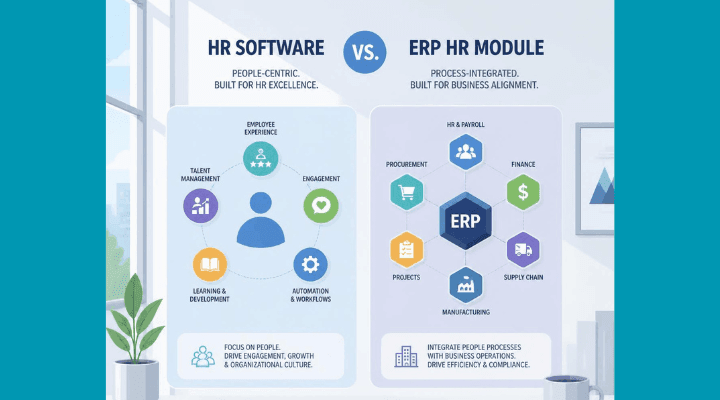
An ERP HR module is built outward from the general ledger, so it is excellent at what an employee costs, which cost centre they belong to and how payroll posts to the accounts. Dedicated HR software is built outward from the employee, so it is better at what the employee does, asks for and experiences. The difference is not quality, it is centre of gravity, and it predicts almost every specific difference you will find. In India the sharpest practical consequence is statutory currency, because a localisation pack ships on the ERP vendor's release cycle rather than on the government's. The cost difference is not in licences, it is in what a change costs after go-live. Most companies above a few hundred employees end up running HR software for the employee-facing work and posting a salary journal into the ERP, which is a genuine architecture rather than a compromise.
What an ERP HR Module Actually Is
Enterprise resource planning software exists to put a company's transactions on one data model. Purchase, inventory, production, sales, receivables, payables, the general ledger. The ERP HR module was added to that model because people are a cost, and costs belong in the ledger.
That origin is visible in the data model if you look at it. An employee in an ERP is typically a record attached to an organisational unit, a position and a cost centre. Those three things exist because finance and operations need them. The employee's manager, their leave balance, their last appraisal and their reimbursement claim are attributes hung off that record rather than the reason it exists.
Dedicated HR software starts from the other end. The employee is the record, and the employee lifecycle is the spine: applied, hired, onboarded, paid, appraised, promoted, exited. Cost centre is an attribute of the employee, not the other way round. Our piece on the employee lifecycle and HR software sets out that spine in full.
Three different things get called an ERP HR module. Only the first one is.
The HR module inside a general ERP. Bundled, shares the ERP's data model and release cycle, and is usually licensed as part of the suite. This is what the article is about.
A standalone HCM suite from an ERP vendor. A separate product with its own release cycle that happens to integrate well with that vendor's ERP. It is dedicated HR software with a strong integration story, and most of section 3 does not apply to it. Do not assume you have one because the logo matches.
An accounting package with a payroll add-on. Not an ERP at all. Different comparison, and generally a much smaller one.
Establishing which of the three you actually have is the first step, because the answer changes the argument entirely and the sales conversation will not always distinguish them for you.
The Difference That Explains the Others
One sentence predicts most of what follows. An ERP HR module is optimised for reporting about employees. Dedicated HR software is optimised for transacting with them.
Reporting about employees means headcount by cost centre, salary cost by department against budget, provisions, the payroll journal, manpower cost per unit produced. An ERP is genuinely excellent at this, better than most HR software, because the data already sits next to the financial data it has to be compared against, and no integration stands between the question and the answer.
Transacting with employees means an employee applying for leave from a phone, a manager approving it before a shift, a reimbursement claim with a photographed bill, an investment declaration in January, a payslip downloaded at eleven at night for a loan application, a shift swap agreed between two operators. These are high-frequency, low-value interactions with people who do not have an ERP licence, have never been trained, and will simply ask HR instead if the system is awkward.
That is the whole difference and it is worth being precise about the consequence. When employee self-service is awkward, it does not fail visibly. Employees route around it. HR becomes the interface to the system, requests arrive by message and email, and somebody starts keeping a spreadsheet of leave balances because the authoritative one takes four clicks and a VPN to reach. The ERP reports remain perfectly accurate about a reality that is now being maintained somewhere else.
| Question | Where it is answered better |
|---|---|
| What did we spend on manpower in the Pune plant last quarter, against budget | ERP HR module |
| How does salary cost post to the general ledger by cost centre | ERP HR module |
| What is our provision for gratuity and leave encashment | ERP HR module |
| Can a machine operator check their leave balance on a phone | HR software |
| Can a manager approve an out-of-cycle payment in an hour | HR software |
| Did the wage base change when the Code on Wages came into force | See section 3 |
| Can we run a hiring process and a performance cycle in the same system | HR software |
Statutory Currency, and the Test That Settles It
This is the section worth reading if you skip the rest, and it is the one where the difference is measurable rather than arguable.
Indian payroll statute changed four times in eighteen months. The four Labour Codes came into force on 21 November 2025, and with them a single definition of wages in section 2(y) of the Code on Wages that adds excluded allowances back into the wage base wherever they exceed half of total remuneration. The Employees' Provident Funds Scheme, 2026 and its companion pension and insurance schemes replaced the 1952, 1995 and 1976 schemes on 29 June 2026. The wage ceiling was re-notified at ₹15,000 on 29 May 2026. And on 1 April 2026 the Income-tax Rules, 2026 renumbered the salary returns: the quarterly statement became Form 138 and the salary tax certificate became Form 130.
None of those is obscure. All four change what a payroll must compute or file. And each one has to reach your system through whoever maintains its India localisation.
For dedicated Indian HR software, that is the product. The statutory logic is the thing being sold, the release cycle is the vendor's own, and a change that affects every customer in the country is shipped to all of them.
For a global ERP, the India localisation is one of many country packs, maintained on the suite's release cycle, and often applied by your implementation partner instead of by the vendor directly. That is not negligence. It is what a release cycle designed around annual or half-yearly major versions does when a statute changes in June.
So run this test, on your own installation, before you decide anything.
- Take one employee with a low basic and a large allowance stack. Ask the system what its provident fund wage base is. If it equals the basic salary field, the section 2(y) add-back is not implemented and the contribution has been low since 21 November 2025.
- Ask which scheme the provident fund configuration cites. If the answer is the Employees' Provident Funds Scheme, 1952, the authority is superseded even though the rates are unchanged.
- Ask what form the last quarterly salary statement was filed on. If the answer is Form 24Q for a period after 1 April 2026, the system is behind.
- Ask when each of those three was patched, and by whom.
That is an afternoon's work, and no vendor is involved in any of it. The answers tell you more than a feature matrix, and they are equally fair applied to us: ask a dedicated vendor the same four and expect specific dates.
There is a variant of this test that matters more for a manufacturing or multi-state employer. Professional tax is a state levy with no national slab table, and states revise independently. Ask how many states your installation currently has slabs configured for, when each was last updated, and who updates them. The full picture, including which states levy it at all, is on our professional tax pages. The wider calendar is in the payroll compliance checklist.
Where the ERP HR Module Genuinely Wins
Stated without hedging, because a comparison that cannot name them is not worth trusting.
Financial integration is the requirement. If the primary need is that manpower cost sits in the same data model as everything else, with no interface between payroll and the ledger, an ERP module wins outright and no amount of integration quality closes that gap. There is a real difference between one data model and two systems that agree.
Cost centre accounting is complex. Employees split across projects, work orders or production lines, with labour cost allocated accordingly. This is native to an ERP and awkward almost everywhere else.
Manufacturing, where labour is a unit cost. Manpower cost per unit produced, absorbed into product costing. If that number matters to how the business is run, keeping payroll next to production data is worth a lot. Where the workforce is also large, shift-based and hourly, the honest answer is often a hybrid rather than either extreme, and our manufacturing HRMS page covers that pattern.
Statutory audit and group consolidation. One system, one audit trail, one consolidation across entities. Auditors and group finance functions have a legitimate preference here and it is not bureaucratic.
It is already implemented and working. This is a real argument and it is regularly dismissed too quickly. A working system that people use is worth more than a better system nobody has migrated to. The correct response to "we already have it" is not to override it, it is to run the test in section 3 and let the answer decide.
The common thread is that ERP wins wherever the employee is primarily a cost to be accounted for, and that is a legitimate and common thing for an employee to primarily be.
Where Dedicated HR Software Genuinely Wins
Also five, on the same axis seen from the other end.
Anything an employee touches. Self-service on a phone, without training and without a licence, for the eight or nine things employees actually do: leave, attendance, payslips, tax declarations, reimbursement claims, personal details, shift information, a document request. Adoption here is not a nice-to-have; it is what determines whether the authoritative record stays authoritative.
Statutory currency. Section 3.
Speed of change. A new allowance, a new state, a revised leave policy, a changed approval chain. In dedicated software these are configuration, done by HR in an afternoon. In an ERP module they are frequently a change request with a partner, a quote, a development window and a regression test. The difference is rarely about capability; it is about who is allowed to make the change and how long the queue is.
Attendance at the edge. Biometric devices, mobile punching with location, shift rosters, overtime rules that have to reconcile to a muster roll. This is a large and specific body of work and it is generally not what an ERP HR module was built for. Our attendance management software and leave management software exist because this is where most of the effort in a payroll month actually goes.
Recruitment, onboarding and performance as one flow. Hiring, offer, onboarding, goals and appraisal in the same record as payroll, so a new hire is one record from application to first payslip. Covered by our recruitment software and performance and goal management.
Cost, Ownership and Speed of Change
The licence comparison is the least useful part of this decision and it is where most of the conversation happens.
The ERP module often appears free because the suite is already licensed. Sometimes it genuinely is. Frequently the HR module is separately licensed, per employee, and the "already paid for" claim turns out to cover the platform rather than the module. Establish which before anything else.
What actually decides the total is the cost of change after go-live, and the two categories differ structurally rather than by degree.
| Cost line | ERP HR module | Dedicated HR software |
|---|---|---|
| Licence | Often bundled, sometimes separately licensed per employee | Per employee per month |
| Implementation | Partner-led, longer, usually the largest single line | Vendor-led, shorter |
| A new allowance or leave rule | Frequently a change request, quoted and scheduled | Configuration, by HR |
| A new state registration | Configuration if the localisation supports it, development if not | Configuration |
| A statutory change | Arrives with a localisation patch on the suite's cycle | Arrives with the product |
| Employee-facing change | Rarely attempted | Routine |
| Integration to finance | None needed | A salary journal, posted |
Ownership follows from that table and it is the part nobody puts in the business case. An ERP HR module is usually owned by IT or finance, because it lives inside a system they are responsible for and a change to it is a change to that system. Dedicated HR software is usually owned by HR. That single difference decides how long it takes to change a leave policy, and it explains why the same organisation can find one system responsive and the other slow while both vendors are doing their jobs properly.
Neither arrangement is wrong. But if HR cannot change an HR rule without raising a ticket, that is a governance decision the organisation has made, and it should be made deliberately instead of inherited from wherever the software happens to sit. Our own pricing is published rather than quoted on request, on the pricing page.
The Architecture Most Companies End Up With
Presented as a choice between two systems, this is usually resolved as a division of labour, and the division is stable enough to be worth designing on purpose.
HR software runs everything the employee touches and everything with statutory logic in it: master data, attendance, leave, payroll, statutory computation and filing, recruitment, onboarding and performance. The ERP runs the ledger. Between them sits one interface, and it carries less than people expect.
The salary journal is the main one: a monthly posting of salary cost, statutory liabilities and net payable, by cost centre, into the general ledger. It is a summarised posting, not employee-level detail, which is what keeps it stable when either side changes. A second interface usually carries the cost centre and organisational structure the other way, from the ERP into HR software, so that the department list stays authoritative in one place. Occasionally a third carries new joiner records into the ERP for asset or access provisioning.
That is a small integration surface, it is well-understood, and it fails in visible ways rather than silent ones. It is worth contrasting with the arrangement that causes real trouble, which is two systems both holding employee master data with no agreement about which one is authoritative. That is not an architecture, it is a reconciliation, and somebody spends a day a month on it forever.
The rule that keeps this clean is to decide, per field, which system is the master, write it down, and let the other system be a copy that is never edited. Employee master and everything statutory: HR software. Cost centre, organisational hierarchy and the chart of accounts: ERP. Nothing edited in two places. On the finance side, most mid-market Indian companies are not running a large ERP at all but an accounting package, which is why we post salary journals to Tally, Zoho Books and QuickBooks directly, and produce bank transfer files in the bank's prescribed format. For everything else there is an API.
What Goes Wrong When Both Systems Hold People Data
Section 7 describes the architecture that works. This section describes what happens when the master data line is not drawn, because that is the state most mixed environments are actually in, and the failures are consistent enough to list.
| Failure | How it shows up | Where it is actually caused |
|---|---|---|
| Two employee masters | Headcount in the ERP and headcount in HR differ by a handful every month, and nobody can say which is right | No agreement about which system a joiner is created in first |
| Organisational structure drift | A department that was renamed in one system and not the other, so the cost centre report has an orphan line | Structure edited in both places |
| Cost centre mismatch at posting | The salary journal will not post because a cost centre in the payroll does not exist in the ledger | A new cost centre created in HR software rather than in the ERP, which is the wrong direction |
| Leaver timing | An employee stopped in HR software in the month they leave and closed in the ERP at settlement, so the two disagree for a month, every time | The exit is two processes rather than one |
| Duplicate identifiers | The same person under two employee codes after a transfer between entities | Transfers handled as an exit and a rehire in one system and as a change in the other |
| Reconciliation as a job | Somebody spends a day a month proving the two systems agree | All of the above, unaddressed |
The last row is the summary. None of these is dramatic and none of them causes an outage. They cause a standing monthly cost that nobody budgeted for, and it is a cost that grows with headcount rather than staying flat.
All six are prevented by the same three rules. They are cheap only if you set them before the integration is built.
One system creates a person. A joiner is created in exactly one system, and flows to the other. In practice that is HR software, because the hiring process ends there and because the statutory identifiers are established there. The ERP receives the record.
One system owns the structure. Cost centres, entities and the chart of accounts are created in the ERP and flow into HR software as a list that HR cannot add to. This is the direction that surprises people, and it is the right one: a cost centre that does not exist in the ledger is not a cost centre.
The exit is one process with two effects. Marking a leaver triggers both the payroll stop and the ledger-side closure, rather than each system being told separately by a different person on a different day.
The general principle underneath all three is that a field has exactly one master and every other copy is read-only. Write the list down, field by field, before anybody builds an interface. It fits on one page, it takes an afternoon, and it is the difference between an integration and a reconciliation.
How to Decide, and What to Ask
Answer these honestly and the architecture usually picks itself. Answer them honestly and the architecture usually picks itself.
Run the test in section 3 first. Four questions against your own installation, an afternoon, no vendor. If the wage base is wrong, the scheme citation is superseded and the last quarterly statement went out on Form 24Q, you have your answer and it did not come from a datasheet.
How many of your employees have ever logged into the ERP? If the honest answer is HR and finance, then the employee-facing half of this decision has already been made, and the only question is whether you are going to admit it and buy something for that half.
How long does it currently take to change a leave rule? Measured from the day HR decides to the day it is live. If that number is measured in weeks, the constraint is ownership rather than capability, and a second system will not fix it unless the ownership moves with it.
What is genuinely one data model, and what is a monthly journal? Manpower cost against budget by cost centre is one data model and it is worth protecting. Employee leave balances are not, and treating them as though they were is what produces the reconciliation described in section 7.
Then ask both kinds of vendor the same things. A good vendor in either category answers all of these without a follow-up call.
- Is the provident fund wage base computed under section 2(y) of the Code on Wages including the one-half add-back? Ask to see it on a structure with large allowances.
- On what date did your India localisation ship support for the Labour Codes commencement, the 2026 provident fund schemes, and the Income-tax Rules, 2026 form renumbering? Ask for three dates.
- Who applies statutory patches: you, or our implementation partner? What has that cost historically?
- How many states of professional tax are configured, and who updates them?
- What does an employee see on a phone, without training and without a named licence?
- What is the cost and elapsed time for a new allowance, a new state and a changed approval chain?
- What integrates with our ledger, and is the posting summarised or employee-level?
- Where is the data hosted and which certifications do you hold? Ask for the certificate rather than the claim.
For the record, since it is fair to answer our own questionnaire: Engage is ISO 27001 certified and hosts data in an Indian data centre region. We are not SOC 2 certified and do not claim to be. Beyond provident fund, ESI, professional tax and salary tax we handle labour welfare fund, the quarterly salary statement, investment declarations and proofs, and bonus computation under the Payment of Bonus Act. We post salary journals to Tally, Zoho Books and QuickBooks, and support single sign-on with Google Workspace, Microsoft Entra ID and Okta. The compliance surface in full is in our Indian payroll compliance software guide, and the wider evaluation is in our HR software buyer's guide.
Questions People Ask
What is the difference between HR software and an ERP HR module?
Centre of gravity. An ERP HR module was built outward from the general ledger, so an employee is a record attached to a cost centre, a position and an organisational unit, and the module is excellent at what people cost, how payroll posts to the accounts and how manpower compares to budget. Dedicated HR software was built outward from the employee, so the lifecycle is the spine and cost centre is an attribute. That single difference predicts most of the specific ones: an ERP module is optimised for reporting about employees and dedicated software is optimised for transacting with them, which is why self-service, speed of change and statutory currency fall the way they do.
Can an ERP HR module handle Indian payroll compliance?
Many can, and the question is not whether it can but how quickly it does. Indian statute changed four times in eighteen months: the Labour Codes on 21 November 2025 with a new wage definition, the provident fund schemes on 29 June 2026, the wage ceiling re-notification on 29 May 2026 and the salary form renumbering on 1 April 2026. Each reaches an ERP through an India localisation pack maintained on the suite's release cycle and frequently applied by an implementation partner. For dedicated Indian software the statutory logic is the product itself. Rather than take a view on it, run the test: check whether your system computes the wage base under section 2(y) with the one-half add-back, which provident fund scheme it cites, and what form the last quarterly salary statement was filed on.
Is it cheaper to use the HR module in our existing ERP?
On licence, often, though establish first whether the HR module is genuinely bundled or separately licensed per employee, because the "already paid for" claim frequently covers the platform rather than the module. On total cost, the licence is not what decides it. What decides it is the cost of change after go-live: a new allowance, a new state, a revised approval chain or a leave rule. In dedicated software those are configuration done by HR. In an ERP module they are frequently a change request with a partner, a quote and a development window. Count the changes your organisation made in the last year, price both models against that number, and the licence comparison stops being the interesting one.
Should HR software replace the ERP?
No, and that is not the choice. The two do different work well and the architecture most companies settle into keeps both: HR software runs everything the employee touches and everything with statutory logic in it, the ERP runs the ledger, and one summarised monthly salary journal posts between them by cost centre. That is a small, well-understood integration surface. What causes real trouble is the arrangement where both systems hold employee master data with no agreement about which is authoritative, because that is not an architecture, it is a monthly reconciliation somebody performs forever.
Which is better for a manufacturing company?
Usually both, with the split drawn carefully. If manpower cost per unit produced is a number the business is run on, keeping payroll cost next to production data in the ERP is worth protecting. But a large shift-based hourly workforce is also the hardest case for employee self-service, biometric attendance, roster management and overtime that has to reconcile to a muster roll, and those are the areas an ERP HR module is least likely to have been built for. The practical answer is dedicated software for attendance, leave and payroll, with the salary journal posting into the ERP by cost centre.
Who should own the HR system, HR or IT?
Whoever owns it decides how fast an HR rule can change, so the question is really about the queue, not the org chart. An ERP HR module is usually owned by IT or finance because a change to it is a change to a system they are responsible for, and dedicated HR software is usually owned by HR. Neither is wrong, but if HR cannot change a leave policy without raising a ticket, that is a governance decision the organisation has made and it should be made deliberately rather than inherited from where the software happens to sit. Measure the current elapsed time from decision to live and treat that number as the input.
What should we ask our ERP vendor before deciding?
Three dates and one demonstration. Ask on what date the India localisation shipped support for the Labour Codes commencement of 21 November 2025, for the 2026 provident fund schemes, and for the Income-tax Rules, 2026 renumbering that made the quarterly salary statement Form 138. Then ask them to show the provident fund wage base on an employee with a low basic and a large allowance stack, and confirm the one-half add-back under section 2(y) is applied. Also ask who applies statutory patches, you or the implementation partner, and what that has cost historically. Ask a dedicated vendor exactly the same questions.
What goes wrong when an ERP and HR software both hold employee data?
Six, and they recur: two employee masters that disagree by a handful of people every month, organisational structure renamed in one system and not the other, a salary journal that will not post because a cost centre exists in payroll but not in the ledger, leavers stopped on different dates in each system, the same person under two employee codes after an inter-entity transfer, and somebody spending a day a month proving the two agree. None causes an outage, which is why none gets fixed. Three rules prevent all six: one system creates a person and it should be the HR system, one system owns cost centres and the organisational structure and it should be the ERP, and an exit is one process with two effects rather than two processes.
How long does it take to run HR software alongside an ERP?
Weeks, not months, for the integration itself. It carries a summarised monthly salary journal by cost centre into the ledger, usually a cost centre and organisational structure feed the other way, and occasionally a joiner feed for asset provisioning. What takes the time is the data migration and the decision about which system masters which field. Write that down field by field before anything is built, let the other system hold a copy that is never edited, and the integration stops being the risky part of the project.
Where This Leaves You
Run the test in section 3 first. An afternoon on it settles most of what follows.
Run the test in section 3 on your own installation. Whether the provident fund wage base applies the section 2(y) add-back, which scheme the configuration cites, what form the last quarterly salary statement went out on, and when each was last patched. Four questions, no vendor, and the answers settle more than any comparison will.
Count how many of your employees have logged into the ERP in the last quarter. If the answer is HR and finance, the employee-facing half of this decision has already been made and it is only a question of whether you fund it.
Draw the master data line on paper before anybody builds an integration. Employee master and everything statutory in one system, cost centre and organisational hierarchy in the other, nothing edited in two places. Most of the trouble in mixed environments comes from skipping this and discovering it a year later.
If the test in section 3 came back badly, that is not an argument for replacing your ERP. It is an argument for moving the statutory and employee-facing work to something whose release cycle follows the statute and not a suite version, and posting a journal to the ledger. That is what our HR management software and payroll management system are built to do, and the journal posting is the boring part rather than the hard part. Book a demo, bring the three dates your ERP vendor gave you, and ask us the same questions.
Related reading: how to calculate payroll in India, payroll software versus payroll outsourcing, replacing Excel with HR software, and the employee lifecycle guide.
Sources
- Code on Wages, 2019, enacted text on India Code. Section 2(y) on the definition of wages and the one-half proportion rule that the test in section 3 turns on.
- Ministry of Labour and Employment, labour.gov.in. Commencement of the four Labour Codes on 21 November 2025, the Employees' Provident Funds Scheme, 2026 and its companion schemes effective 29 June 2026, and the ₹15,000 wage ceiling notified on 29 May 2026 under Chapter III of the Code on Social Security, 2020.
- Income Tax Department, incometax.gov.in. The Income-tax Act, 2025 governing salary paid from 1 April 2026, and the Income-tax Rules, 2026 renumbering the quarterly salary statement and the salary tax certificate.
- Employees' Provident Fund Organisation, epfo.gov.in. Contribution rates and the wage base on which they are computed.
Nothing above describes any particular vendor's product or release history. The tests in sections 3 and 8 are written to be run against your own installation and to be asked of every vendor equally, including us.